For the better part of the last decade, the cybersecurity industry has beaten a single drum: "”shift left.” The premise was highly logical, finding vulnerabilities earlier in the software development life cycle (SDLC) to reduce remediation costs and deployment friction. But as we navigate the complexities of software delivery in 2026, a harsh reality has set in for Platform Engineers, Lead Developers, and DevSecOps teams alike: shifting left is broken.
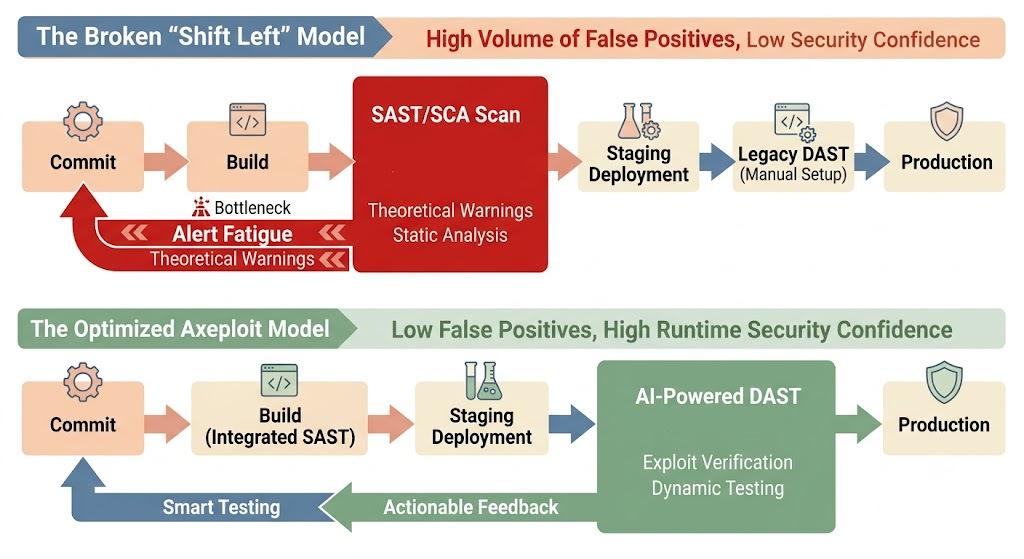
By overloading early pipeline stages with Static Application Security Testing (SAST) and Software Composition Analysis (SCA), we haven't eliminated risk; we’ve simply shifted the burden. We’ve buried developers under mountains of theoretical warnings and false positives. More importantly, static tools are inherently blind to the most critical threats facing modern applications, runtime business logic flaws, complex IDORs (Insecure Direct Object References), and authorization bypasses.
To genuinely secure modern architectures without sacrificing velocity, the industry must evolve past static myopia. This article explores why legacy static analysis is insufficient on its own and outlines the architectural necessity of integrating a true, AI-driven dynamic application security testing (DAST) engine directly into your CI/CD pipelines.
The Reality of “Shift Left Security”: Alert Fatigue and Theoretical Risks
The core philosophy behind shift left security was meant to empower development teams. By integrating security plugins directly into Integrated Development Environments (IDEs) and triggering SAST scans on every pull request, the goal was to catch poor coding practices before they were ever compiled.
However, SAST tools evaluate the application from the inside out. They analyze raw, uncompiled source code or binaries without any understanding of the broader context of the running environment. This fundamental limitation results in a staggering volume of alerts. A developer might receive a “critical” warning for a vulnerable cryptographic library that, in reality, is never invoked in a publicly accessible path. Alternatively, they might see a SQL injection alert on a backend endpoint that is entirely mitigated by strict sanitization and Web Application Firewall (WAF) rules at the API gateway.
The downstream result is profound alert fatigue. When 80% of security warnings are theoretical, developers begin to tune them out, inevitably missing the 20% that actually pose a threat. Shift left security, in its current SAST-heavy iteration, has unintentionally created a culture of ignoring the dashboard rather than securing the product.
DAST vs SAST: The Missing Runtime Context
To understand why shifting left has hit a wall, we must critically evaluate the fundamental differences in the DAST vs SAST paradigm.
SAST is akin to inspecting the architectural blueprints of a bank. You can see if the vault door is designed to be thick enough, but you cannot tell if the teller is actually checking IDs before handing over the cash. SAST catches structural flaws: hardcoded secrets, known vulnerable open-source dependencies, and basic syntax-level injection vectors.
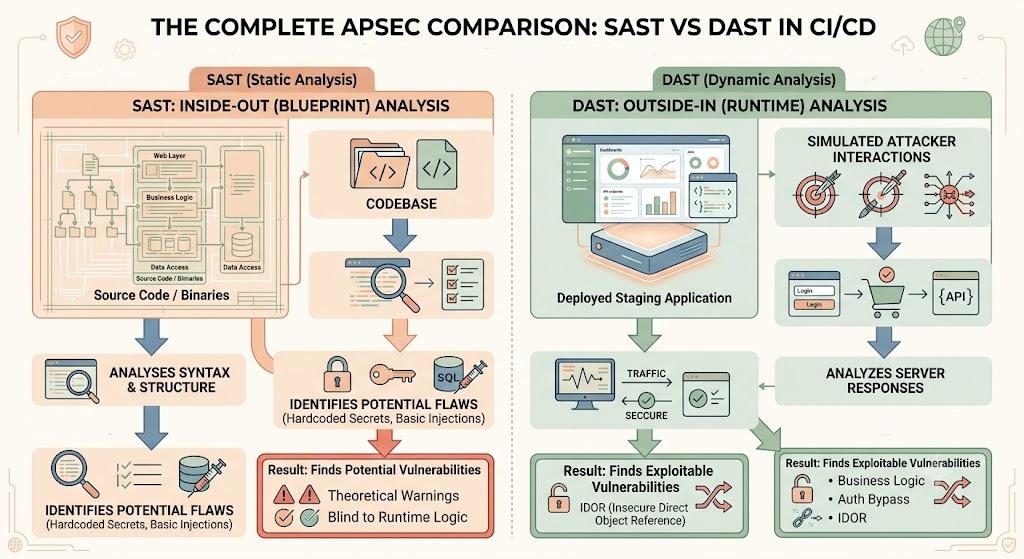
Dynamic application security testing, on the other hand, operates from the outside in. It simulates how an actual attacker interacts with the deployed, running application in a staging or test environment. This runtime context is absolutely non-negotiable for securing modern web applications and interconnected microservices.
Legacy SAST tools fundamentally cannot detect the issues that cause the most devastating breaches today:
- Authentication and Authorization Flaws: Over 30% of critical vulnerabilities originate from auth workflows, such as email verification failures, weak session tokens, and mobile OTP (One-Time Password) bypasses. A static code scan cannot test the stateful lifecycle of an OTP validation.
- Business Logic Vulnerabilities: These are flaws where the application operates exactly as coded, but the underlying business logic can be exploited (e.g., submitting negative pricing in an e-commerce cart, or skipping a mandatory checkout step).
- Insecure Direct Object References (IDOR): Determining whether User A can access User B's private invoice simply by incrementing an integer in the API URL requires stateful, contextual awareness that static analysis entirely lacks.
Legacy DAST and the Speed Bump in CI/CD Pipeline Security
If DAST is the obvious answer to SAST's glaring blind spots, why haven't we simply shifted DAST left? The answer lies in the heavy, outdated limitations of legacy DAST architecture.
Historically, dynamic scanning has been the antithesis of agile development. Traditional DAST tools are notoriously slow and incredibly difficult to configure. They require security engineers to manually map API endpoints, share delicate user credentials, and meticulously record session flows (HAR files) just to get the scanner to log into the application properly.
By the time a legacy DAST tool is configured and finishes its days-long crawl of a staging environment, the development team has already merged code and pushed three new microservices to production. This creates severe continuous deployment risks. Because legacy DAST is simply too slow for the pipeline, it gets pushed out-of-band, relegated to a monthly or quarterly compliance checkbox rather than an active guardrail. When vulnerabilities are finally uncovered weeks later, they are deeply entrenched in production code, exponentially increasing the cost, time, and engineering effort required for remediation.
The Architectural Shift: Integrating an AI Vulnerability Scanner
The solution to securing modern infrastructure is not to abandon dynamic testing, but to overhaul it completely. Today, the convergence of Large Language Models (LLMs) and autonomous agents has made it possible to deploy an AI vulnerability scanner that thrives in high-velocity pipelines.
To achieve robust CI/CD pipeline security without sacrificing speed, DAST must be reimagined with the following architectural tenets:
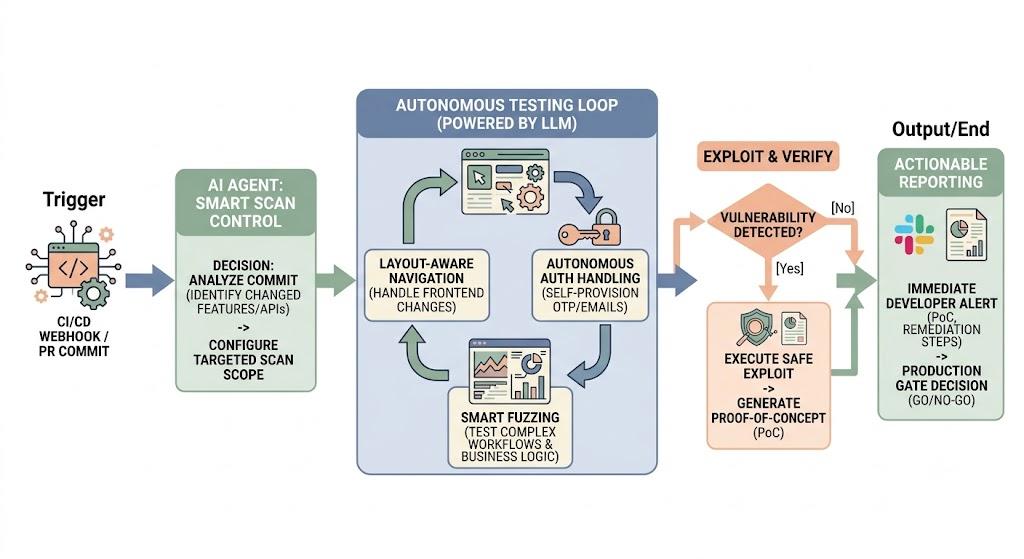
- Zero-Configuration and Autonomy: Modern DevSecOps teams do not have the bandwidth to maintain fragile API integration scripts. An AI-powered DAST tool must act like a synthetic, intelligent user. It needs to autonomously locate signup pages, provision its own test accounts (using its own dedicated mobile numbers and email addresses), handle mobile OTPs, and navigate complex auth workflows without any manual credential seeding or session recording.
- Smart Scan Control (Targeted Testing): Running a comprehensive scan against an entire application infrastructure on every single pull request is a non-starter. AI-driven DAST must integrate directly with CI/CD platforms (via webhooks or native integrations) to analyze the specific commit. It should then execute a highly targeted scan only on the newly introduced features, updated APIs, or high-risk endpoints, keeping scan times to mere minutes.
- Layout-Aware Intelligence: Modern single-page applications (SPAs) and frontends are incredibly dynamic. Legacy scanners break immediately when a UI button moves or a DOM element changes. An LLM-powered testing engine adapts to frontend changes in real-time, understanding the semantic purpose of page elements to maintain its testing flow without requiring human intervention.
- Exploit Verification over Theoretical Noise: Instead of flagging a "potential" issue, an intelligent scanner leverages a massive fuzzing database and continuously updated CVE intelligence to actively, and safely exploit the flaw in staging. If the tool reports an IDOR, it provides the exact proof-of-concept payload demonstrating how User A compromised User B’s data. This eliminates false positives and gives developers undeniable, actionable truth.
Reclaiming the CI/CD Pipeline and Developer Experience
Integrating AI-driven dynamic testing into the pipeline fundamentally transforms the developer experience. Instead of sifting through hundreds of SAST-generated false positives in a bloated dashboard, developers receive a targeted Slack alert immediately after a staging build. This alert details exactly how an autonomous agent just bypassed their newly committed payment gateway logic, complete with the reproduction steps.
This is the true realization of shifting left: providing high-fidelity, highly contextual, and entirely actionable feedback loops at the exact speed of development.
Conclusion
The core mandate for shift left security remains entirely valid, but its practical execution over the last few years has been profoundly flawed. We have optimized for the speed and simplicity of static analysis at the severe expense of accuracy, leaving our most critical application layers, business logic and complex authentication workflows, wide open to exploitation. Relying solely on SAST and SCA creates a dangerous illusion of safety, leaving modern infrastructures vulnerable to the exact runtime exploits that sophisticated attackers prioritize today.
To fix the pipeline, we must bring the realism of dynamic application security testing up to the speed of modern DevOps. By replacing cumbersome, manual legacy scanners with an intelligent AI vulnerability scanner, organizations can finally achieve zero-config, autonomous testing that adapts to code changes in real time. This isn't just about finding more bugs; it’s about finding the right bugs, verifiable, exploitable risks, without breaking your deployment cadence.
As we push forward in 2026, the engineering teams that succeed will be those who stop chasing theoretical static warnings and start deploying intelligent, AI-driven agents that test their applications precisely the way an adversary would.