A breach does not begin with a dramatic headline. It begins quietly, usually with one overlooked flaw, one misconfigured permission, one exposed endpoint, or one assumption that nobody challenged in time. By the time founders notice anything unusual, the attacker may already have moved through the system, accessed data, and established a timeline that the company will spend weeks or months trying to unwind.
That is what makes breach risk so hard for non-technical leaders to judge. Before an incident, security feels abstract. After an incident, every hour suddenly matters. The first few hours affect containment, the first day affects trust, the first week affects legal and operational pressure, and the weeks after that determine whether the company emerges with its reputation intact or permanently damaged.
Hour 0 to Hour 6
The earliest phase is usually confusion. An alert fires, a support team notices strange behavior, a customer reports something odd, or an engineer sees a pattern that does not fit normal traffic. At this stage, nobody knows the full scope yet. The immediate question is not “how bad is it?” but “what is still happening right now?”
For founders, this is often the most stressful point because the business cannot yet separate rumor from reality. Product teams want to keep serving customers. Engineers want to investigate. Leadership wants a clear answer. But clarity takes time, and attackers do not pause while the team gets organized. If the system is still exposed, every minute can mean more data loss, more account compromise, or more evidence being destroyed by normal system activity.
This is the first reason proactive scanning matters. If a flaw had been identified earlier, this phase might never have existed. The earliest hour of a breach is often a delayed security review showing up as an emergency.

Hour 6 to Hour 24
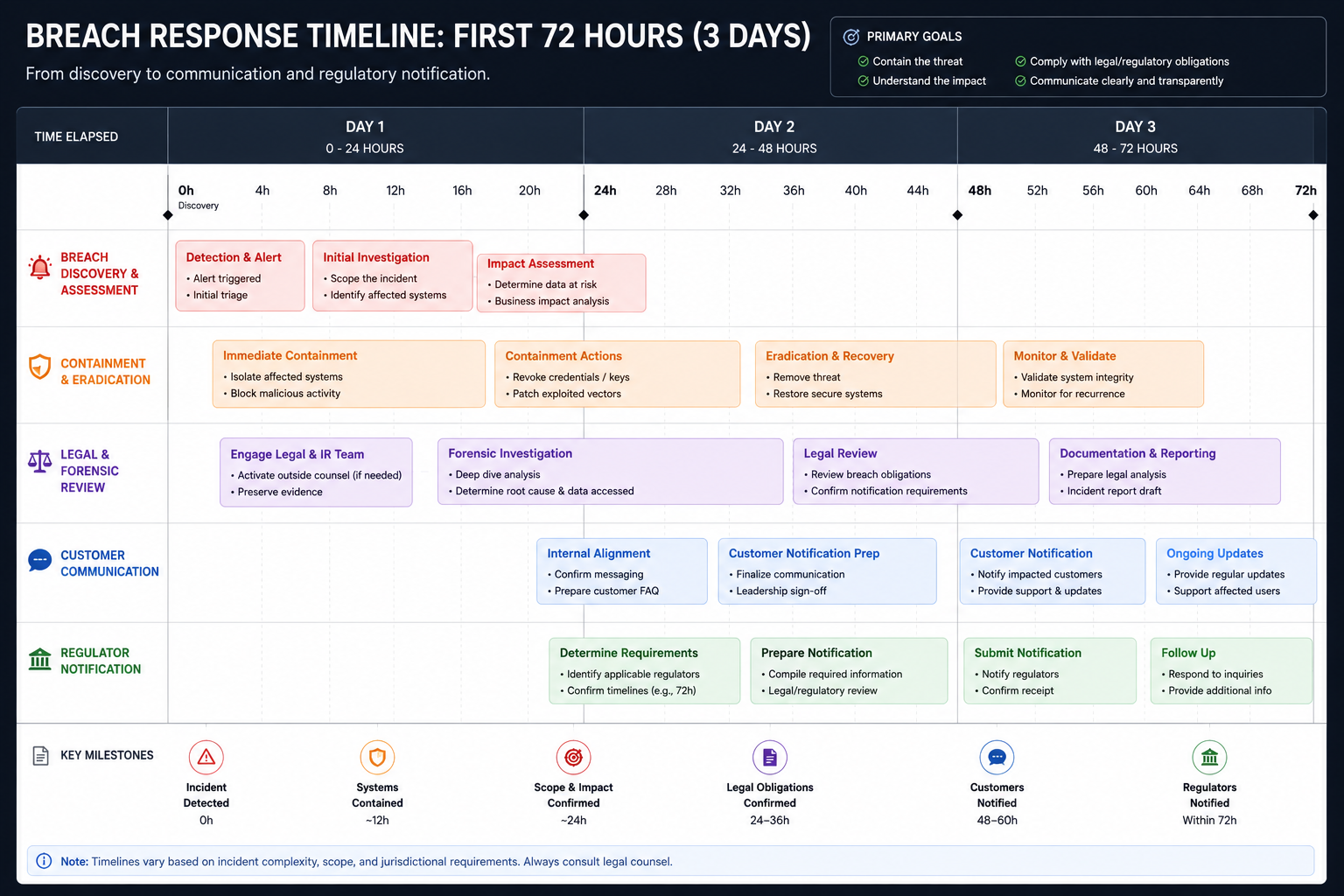
Once the team confirms something is wrong, the incident changes from a technical event into an organizational one. Access may need to be disabled, credentials may need to be rotated, logs may need to be preserved, and containment decisions may need to be made fast. Every action has tradeoffs. Shutting down a system too aggressively can disrupt customers. Leaving it open can allow further abuse.
This is also the point where internal communication becomes critical. Founders may need to brief investors, board members, legal counsel, customers, and key partners. Even if the incident is still under investigation, silence is not always an option, especially if customer data may have been affected. The company has to begin preparing for notification, because the clock is already running.
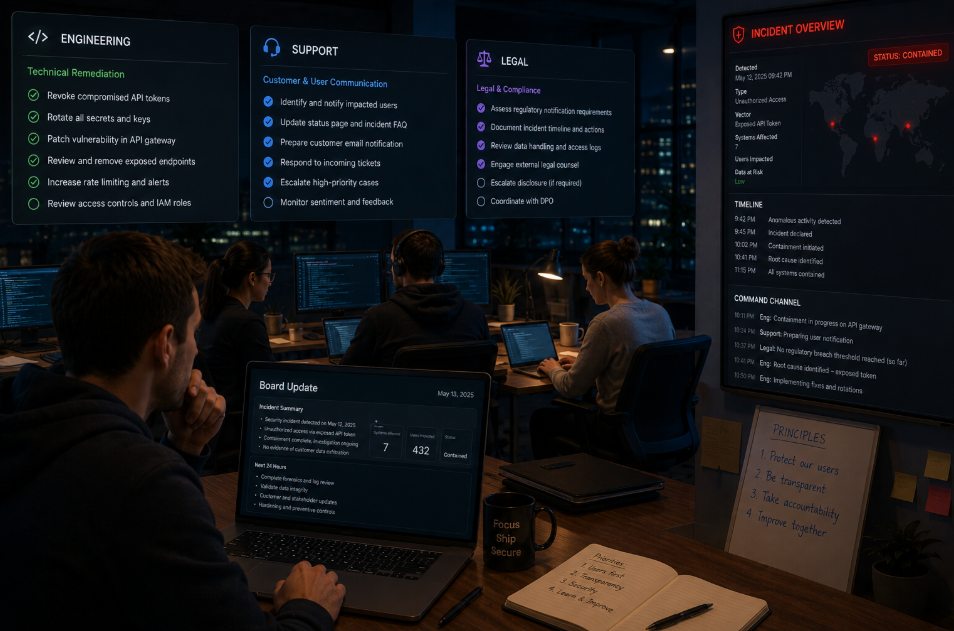
For non-technical leaders, this is often the first shock: a breach is not just a security problem, it is a coordination problem. The product, legal, support, communications, and engineering teams all suddenly share one timeline. One weak control can become a company-wide workload.
Day 1 to Day 3
By the first few days, the breach has usually become real in a way nobody can ignore. The team may know which systems were touched, what kind of data may have been accessed, and what steps are needed to reduce harm. This is the stage where trust damage begins to form, because customers are waiting to hear whether their data or accounts were affected.
Notification obligations can also start to take shape here. Depending on the nature of the data and the jurisdictions involved, the company may need to evaluate whether regulators, customers, or partners must be informed. That process is rarely simple. Leaders have to balance accuracy, speed, and legal exposure while still giving people enough information to take protective action.
This is also when the story starts escaping the company. Support tickets, customer rumors, employee chatter, and partner questions can spread uncertainty faster than the official response. If the company does not communicate clearly and credibly, the breach narrative can be defined by speculation instead of facts.
Day 3 to Day 7
During the first week, the breach stops being an emergency and starts becoming a business issue. Customers may ask hard questions about what was exposed, whether the issue was preventable, and why it was not caught earlier. Sales conversations may stall. Enterprise prospects may pause procurement. Existing customers may demand written assurances or security reviews.
This is also when the long tail of operational work appears. Incident reports need to be written. Evidence needs to be preserved. Logs and access history need to be reviewed. Product and engineering teams may need to rebuild assumptions around trust boundaries, authentication, and access control. What looked like one vulnerability often reveals a broader pattern of weak detection or incomplete testing.
For founders, this stage is painful because it turns a technical failure into a credibility test. If the company appears unprepared, the market notices. If the response looks slow or vague, trust erodes further. A breach is not only about what happened. It is also about how the company behaves once it knows.
Week 2 to Week 4
By the second and third week, the business impact becomes measurable. Legal exposure may still be developing, especially if there are contractual, privacy, or sector-specific obligations involved. Security reviews from customers may intensify. Support load may increase. Internal morale may dip as teams realize how much time the incident has consumed.
This is the point at which founders often realize the true cost was never just the technical fix. It was the lost time, the slowed roadmap, the distraction from growth, and the damage to confidence. A product team that should have been shipping features is now answering questions about controls, evidence, and remediation. A leadership team that should have been focused on strategy is now managing incident fallout.
The deeper lesson is that breach response is expensive even when the compromise is contained quickly. When it is not contained quickly, the cost multiplies. The longer the exposure exists before detection, the more likely it is that customer data, operational trust, and external relationships all take a hit at once.
The trust collapse
The most underestimated effect of a breach is not always the data itself. It is the change in how people perceive the company. Customers start asking whether the product is safe to use. Investors start asking whether the team had enough process. Partners start asking whether the company can be trusted with sensitive workflows.
Trust is difficult to rebuild because it depends on confidence, and confidence depends on evidence. A company can say it has fixed the issue, but customers often want to know why the issue existed, whether similar problems may still exist, and what controls are now in place to prevent a repeat. That means breach response is not just about recovery. It is about proving that the organization learned something real.
This is why prevention is so much cheaper than reaction. A proactive scan that finds auth bypass, enumeration, secret exposure, or access-control flaws before release prevents the company from ever entering this trust crisis. Every issue caught early is one less explanation the founders have to give later.
Regulatory and legal pressure
For many companies, the breach timeline eventually reaches legal and regulatory scrutiny. The exact obligations depend on what data was involved, where users are located, and what laws or contracts apply. Even when the technical incident is over, the company may still be dealing with notifications, audits, insurance questions, and potential claims.
This phase is especially hard for non-technical leaders because it can feel detached from the original cause. What began as an insecure API, a leaked credential, or a weak control has now become a legal and reputational problem. The farther the breach travels from the root cause, the more obvious it becomes that security is a business function, not just an engineering concern.
That is why founders should care about security work that seems mundane. The cost of scanning, testing, and verifying controls is small compared with the cost of explaining a breach after the fact. The timeline makes that difference painfully clear.
Why prevention wins
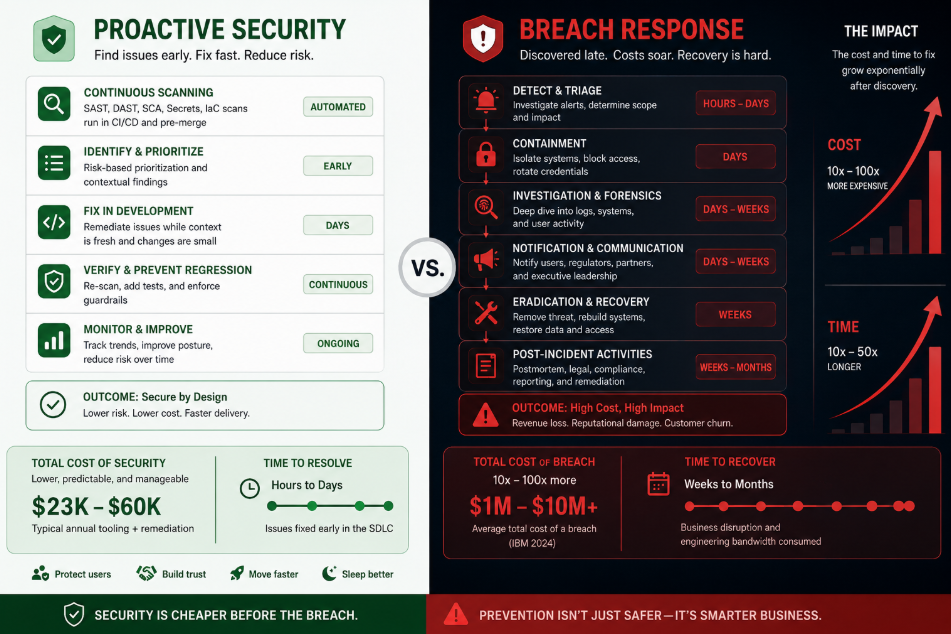
The simplest lesson from breach timelines is that time is the enemy. Every hour before detection increases the chance of damage. Every day before containment increases the chance of trust loss. Every week before closure increases the chance of legal and operational drag. The best security program is the one that prevents the company from ever entering that timeline in the first place.
That is where proactive scanning becomes part of the business case. It is not only about finding vulnerabilities. It is about shortening the path to certainty. When founders know their application has been checked for common real-world abuse patterns, they reduce the odds of waking up to a timeline they cannot control.
For Axeploit, this is the clearest positioning possible: proactive scanning is not a nice-to-have. It is the cheapest way to avoid an expensive breach story later. If the product can validate authentication, enumeration, secret exposure, and other real-world abuse paths early, it helps founders buy back the only thing a breach never gives back: time.
Final perspective
A breach is never just one moment. It is a sequence of escalating consequences that begins with uncertainty and ends with hard questions about trust, compliance, and leadership. Founders who understand that timeline make better decisions before the incident, because they can see what is actually at stake.
The right takeaway is not fear. It is urgency. If every hour after a breach is expensive, then every hour before a breach is valuable. That is why proactive scanning, verification, and security testing are not overhead. They are the work that keeps the company out of a timeline it will wish it had never entered.