Modern enterprises are adopting AI tools faster than they can govern them. Teams are connecting large language models to internal systems, SaaS apps, databases, and developer tools through lightweight integrations that often bypass normal approval paths. That convenience is exactly why these integrations are becoming a new form of shadow IT: they are easy to deploy, difficult to inventory, and often more privileged than the teams operating them realize.
What MCP Actually Changes
The Model Context Protocol, or MCP, is designed to standardize how AI applications interact with external systems. In practice, it creates a bridge between an AI client and enterprise tools such as email, file systems, databases, ticketing platforms, and internal APIs. That makes it powerful for automation, but it also means the AI layer can gain direct access to live tools and sensitive data.
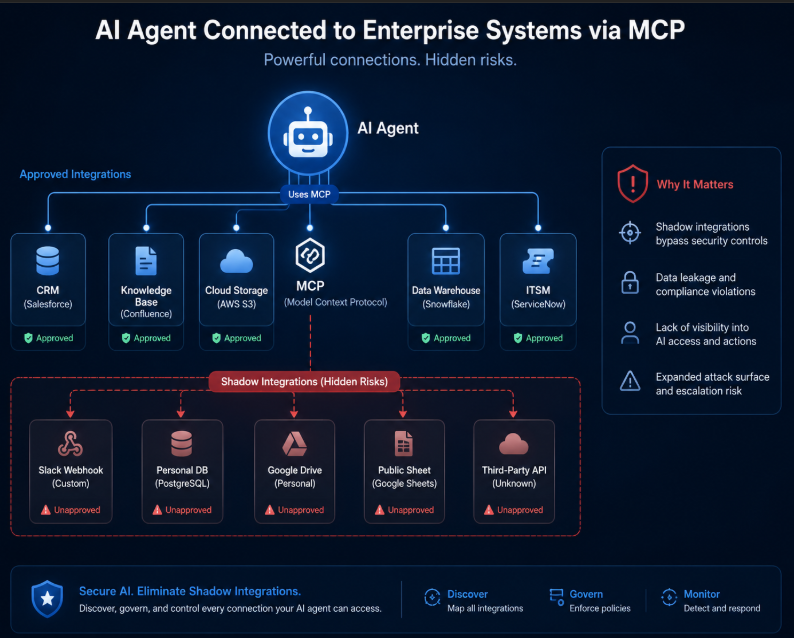
The security challenge is not the protocol itself; it is how quickly organizations adopt it without strong governance. Once a tool integration becomes part of an AI workflow, it can disappear from normal security visibility. Traditional asset inventories may track servers and apps, but they often miss the “glue” layer that connects AI agents to business-critical systems.
Why It Resembles Shadow IT
Shadow IT became a major risk because employees adopted unsanctioned software that handled company data outside security oversight. MCP creates a similar problem, but with more complexity. Instead of one unapproved app, organizations may end up with dozens of AI tool bridges, local developer servers, and automation connectors that are invisible to central governance.
The risk is amplified because these integrations can carry credentials, prompts, tool definitions, and live actions. If an organization does not know which servers exist, what they expose, or who can invoke them, it cannot assess the risk properly. Several security sources now describe this as “Shadow MCP” or “Shadow IT for AI,” emphasizing the governance gap created by unmanaged AI integrations.
Core Security Risks
The first major risk is unauthorized capability discovery. If an attacker or malicious prompt can enumerate what tools an AI agent can access, they gain reconnaissance into internal capabilities and workflows. That turns the integration layer into a map of what can be reached, even when traditional systems remain hidden behind APIs or local tooling.
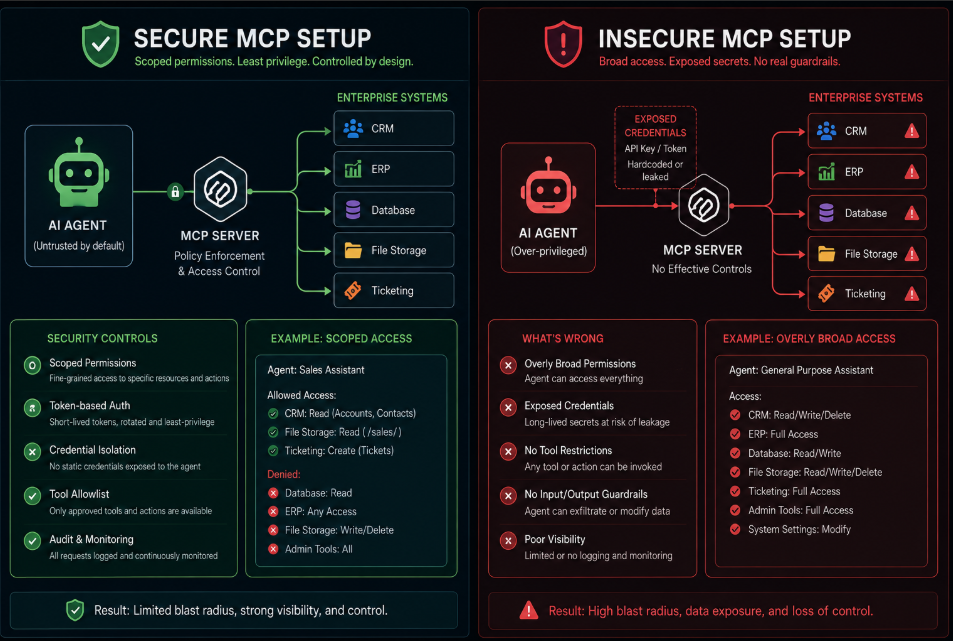
The second risk is over-scoped execution. If an MCP server is connected with broad permissions, a compromised agent or abused prompt may trigger actions far beyond the intended task. That can lead to data access, workflow manipulation, or unintended changes in production systems.
The third risk is supply-chain exposure. Fast-moving MCP ecosystems may rely on SDKs, third-party servers, or libraries that have not been hardened to enterprise standards. Security reporting has also pointed to cases involving outdated OAuth components and weak token validation in MCP implementations, which shows how integration risk can become credential risk very quickly.
Why Traditional Controls Miss It
Most security programs are built around endpoints, SaaS accounts, cloud infrastructure, and application logs. MCP sits between those layers. It can live inside a developer workstation, a local runtime, a CI workflow, or a hidden service that only AI clients know how to reach. That makes it easy to overlook during standard audits.
Logging and monitoring are also inconsistent across these environments. Even if a tool is technically documented, security teams may still miss how often it is used, what data it sees, and whether the AI client has permission boundaries that make sense. This is why organizations are being urged to move from asset-centric thinking to capability-centric thinking: not just “what systems exist,” but “what actions can AI actually perform?”
What Good Governance Looks Like
A better approach starts with inventory. Organizations should map every MCP server, AI connector, and tool bridge across developer machines, internal infrastructure, and third-party services. They should record what each integration can access, what credentials it uses, and whether it can perform read-only or write actions.
Next comes privilege reduction. Credentials should be scoped tightly, tool permissions should be minimal, and high-risk actions should require explicit approval or step-up controls. Tool metadata, schemas, and prompt templates should also be treated as security-relevant inputs because the AI agent reasons over them, which means poor descriptions or unsafe defaults can become part of the attack surface.
Finally, organizations need monitoring and response. That means alerting on unknown integrations, detecting new MCP deployments, and treating unauthorized AI tool connections the same way they would treat unsanctioned SaaS usage or unknown cloud resources. In modern environments, governance is not optional; it is the only way to keep AI automation from becoming a blind spot.
Why This Matters for Security Teams
For security teams, MCP is not just another protocol to evaluate. It represents a shift in how work gets done. AI agents are moving from passive assistants to active operators that can query systems, retrieve data, and execute tasks on behalf of users. That expands both productivity and blast radius.
This is why the shadow IT comparison is so useful. When a technology becomes easy to deploy and hard to see, it becomes a governance problem before it becomes a technical one. Security leaders who understand this early can build controls around discovery, least privilege, and monitoring before the number of integrations becomes unmanageable.
MCP is enabling a new generation of AI workflows, but it is also creating a new class of hidden risk. Unmanaged AI tool integrations behave like shadow IT because they are easy to create, hard to track, and often more privileged than anyone intended. For organizations that want to adopt AI safely, the priority is clear: discover every integration, scope every permission, and monitor every action.