If you are a DevOps Engineer, a Cloud Architect, or a DevSecOps professional operating in 2026, you are likely navigating the most complex infrastructure environments in history. We have successfully automated the heavy lifting of deployment, embraced serverless architectures, and scaled across multi-cloud environments. We are equipped with state-of-the-art enterprise secret vaults, like HashiCorp Vault, AWS Secrets Manager, and Azure Key Vault.
Yet, despite this massive technological leap, the cybersecurity industry is fighting a losing battle against one of the oldest, most preventable vulnerabilities in the book: the hardcoded credential.
Welcome to the Secrets Sprawl Epidemic. As engineering velocity accelerates, developers are inadvertently leaving sensitive API keys, database passwords, and access tokens scattered across repositories, container registries, and chat logs. This article is your pragmatic, DevSecOps-centric guide to understanding why credential leakage is accelerating, how to implement dynamic short-lived credentials, and how automated scanning agents can ensure zero secrets ever reach your production codebase.
The Anatomy of Credential Leakage in 2026
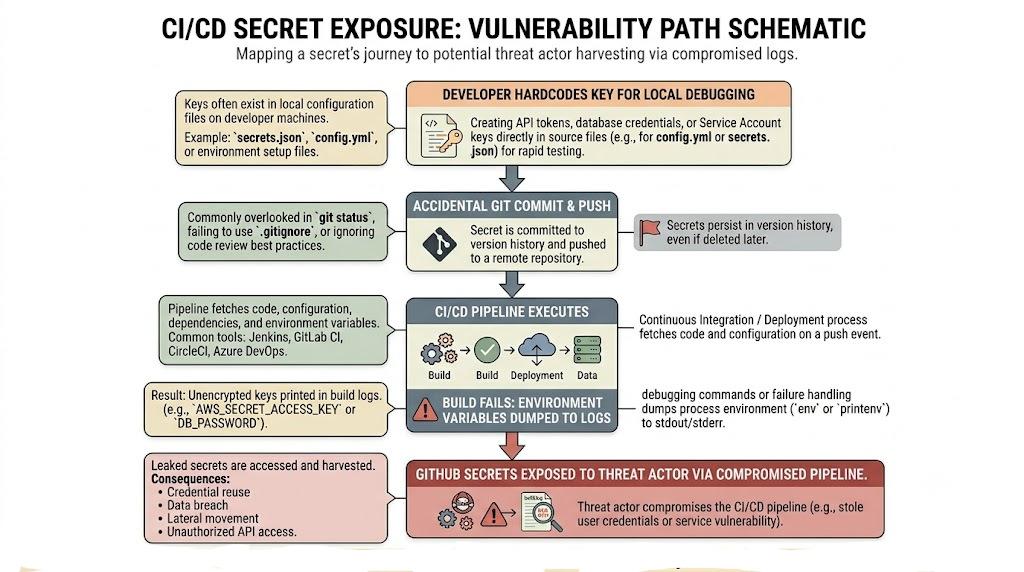
In an ideal world, all sensitive data lives strictly inside a secure vault. But the reality of modern software development is messy. When a developer is debugging a failing microservice at 2:00 AM, the temptation to hardcode an API key "just for a quick local test" is incredibly high. All it takes is one accidental git commit, and that plaintext key is permanently written into your version control history.
Furthermore, the rise of multi-cloud architectures has exponentially multiplied our attack surfaces. A single application might rely on AWS for hosting, Snowflake for data warehousing, Stripe for payments, and OpenAI for localized AI features. Managing the authentication for these disparate services creates friction. When developers experience friction, they look for shortcuts.
This leads to catastrophic credential leakage. Even when teams utilize GitHub secrets to mask variables in their repositories, improper scoping or overly permissive environment variable dumps during a failed build can expose those exact secrets in the plaintext output of your GitHub Actions logs.
The Illusion of the Vault
A common misconception is that purchasing a premium secrets management tool inherently solves the problem. But a vault is only as secure as the mechanism used to open it.
If your application requires a static, long-lived master token to authenticate with HashiCorp Vault, and that master token is hardcoded into a configuration file, you haven't solved the security problem; you have simply moved it. Attackers know this. They no longer bother trying to brute-force your encrypted databases. Instead, they scan your public and private repositories, your Docker images, and your misconfigured S3 buckets looking for the keys to the kingdom.
If your secrets management strategy relies purely on the assumption that developers will never make a mistake, you are severely compromising your CI/CD pipeline security.
A DevSecOps Blueprint for Zero Secrets in Production
To effectively combat the secret sprawl epidemic, organizations must shift from a reactive posture to a proactive, automated defense strategy. Here is the blueprint for locking down your multi-cloud environment.
1. Centralize and Audit Secrets Management
You cannot protect what you cannot see. The first step is to aggressively consolidate your secrets. Eliminate fragmented .env files floating around developer laptops and unify your architecture under a single source of truth. Every secret must be uniquely identifiable, and its usage must be strictly logged. If an API key is accessed at an anomalous time or from an unrecognized IP address, your Security Operations Center (SOC) should receive an instant alert.
2. Shift to Dynamic, Short-Lived Credentials
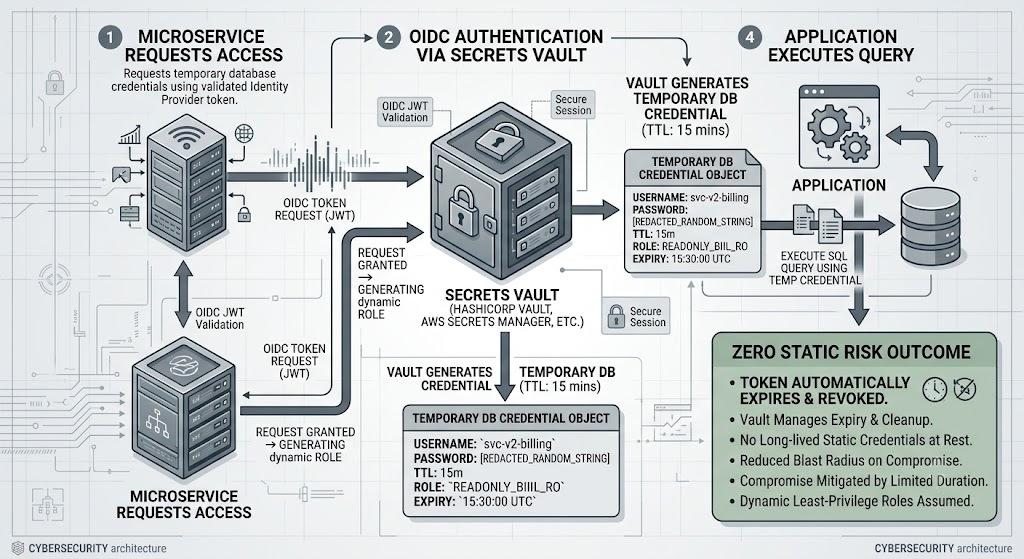
The most secure secret is the one that doesn't exist. Instead of issuing static database passwords or long-lived API keys that remain valid for months, modern infrastructure must utilize Just-In-Time (JIT) access.
By leveraging OpenID Connect (OIDC) or native cloud STS (Security Token Service), your application requests access, and the vault generates a temporary, dynamic credential with a strict Time-to-Live (TTL), often just 15 minutes. Even if an attacker intercepts this token, it becomes mathematically useless before they have the chance to exfiltrate meaningful data.
3. Enforce Automated Scanning in the CI/CD Pipeline
To stop secrets from entering your version control in the first place, you must implement strict "Shift Left" methodologies. This means integrating pre-commit hooks (like GitLeaks or TruffleHog) directly onto developer machines. If a developer attempts to commit a high-entropy string that resembles an AWS access key, the commit is actively blocked before it ever leaves their local environment.
However, relying solely on static pipeline checks is not enough. Complex applications assemble their state at runtime, meaning secrets can still leak into client-side code, exposed debugging dashboards, or unauthenticated APIs.
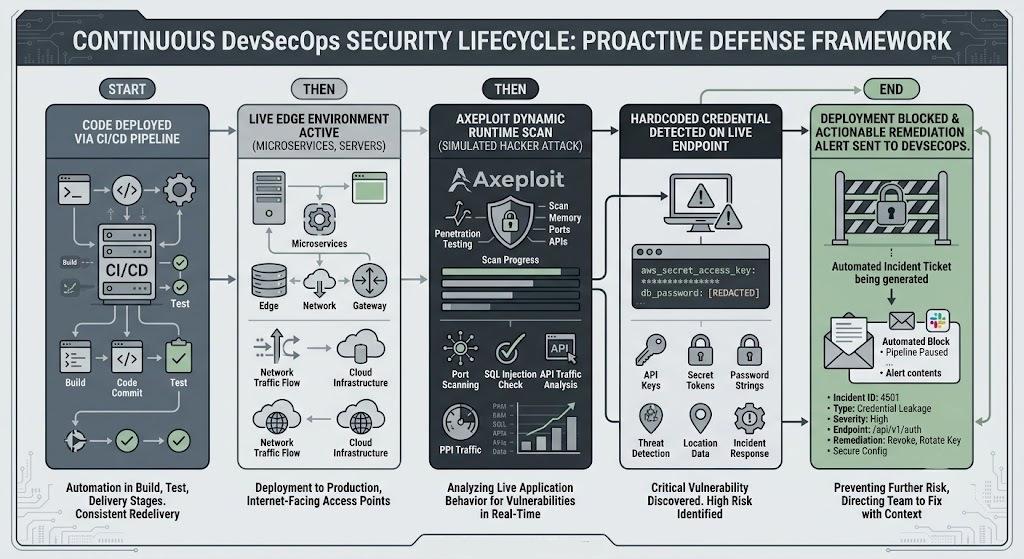
Active Defense: Stopping Sprawl with Axeploit
This is where the paradigm of passive security ends and active DevSecOps begins. Static analysis tools try to guess if your code looks dangerous on paper, but they are fundamentally blind to how your application behaves in the real world.
Axeploit physically tests the reality of your deployed environment. Our automated vulnerability scanner operates exactly like an advanced cybercriminal targeting your assets. While your developers ship code at maximum velocity, Axeploit actively and safely probes your live external perimeters, web applications, and endpoints.
If an upstream CI/CD pipeline misconfiguration accidentally pushes an environment variable containing a Stripe API key to your public frontend, or if a deprecated testing module leaves a backdoor open with hardcoded administrative credentials, Axeploit’s dynamic engine will immediately discover it. We flag the exposed exploit path and provide your platform engineering team with clear, actionable remediation insights to patch the vulnerability at the source.
Conclusion: Automate Your Armor
The transition to multi-cloud ecosystems and AI-assisted "vibe coding" has unlocked unparalleled engineering velocity in 2026. But as our systems grow more unified and deploy faster, the blast radius of a single leaked credential expands exponentially.
You cannot solve a systemic automation problem with manual human review. Securing your infrastructure requires centralizing your vaults, enforcing short-lived ephemeral access, and deploying continuous, dynamic security testing. You must assume your perimeter will be tested, and you must ensure your application's armor is thick enough to withstand human error.