If you manage a multi-cloud environment in 2026, you know that infrastructure is ephemeral. DevOps teams spin up storage buckets, deploy ephemeral staging environments, and integrate third-party SaaS tools at breakneck speed. But while resources are rapidly provisioned and destroyed, the DNS records pointing to them often outlive their usefulness. Cloud sprawl breeds forgotten infrastructure.
This operational disconnect between cloud infrastructure engineering and network management creates one of the most stealthy and damaging blind spots in modern security: the subdomain takeover vulnerability. When a cloud resource is spun down but the DNS record remains active, it leaves a ghost in the perimeter. Attackers aren't just looking for unpatched zero-days. They are actively hunting these ghosts.
This tactical guide breaks down the mechanics of a subdomain takeover, explains how automated reconnaissance exploits cloud sprawl, and demonstrates why adopting continuous, offensive-minded external attack surface management is the only viable defense.
The Mechanics of a Subdomain Takeover Vulnerability
At its core, a subdomain takeover is a logical flaw. It occurs when a DNS record, typically a Canonical Name (CNAME), points to a third-party service or cloud resource that has been deprovisioned, deleted, or expired. This is known as dangling DNS.
Because the third-party provider (like AWS, Azure, Zendesk, or GitHub Pages) still allows new users to claim that specific resource name, an attacker can simply register it themselves. Instantly, the legitimate subdomain resolves to infrastructure controlled entirely by the adversary.
The Attack Chain
To a System Administrator or Cloud Engineer, the process of a takeover looks like this:
- The Setup: Marketing launches a new campaign and requests a customer portal. IT creates a CNAME record: promo.yourcompany.com IN CNAME yourcompany-promo.zendesk.com.
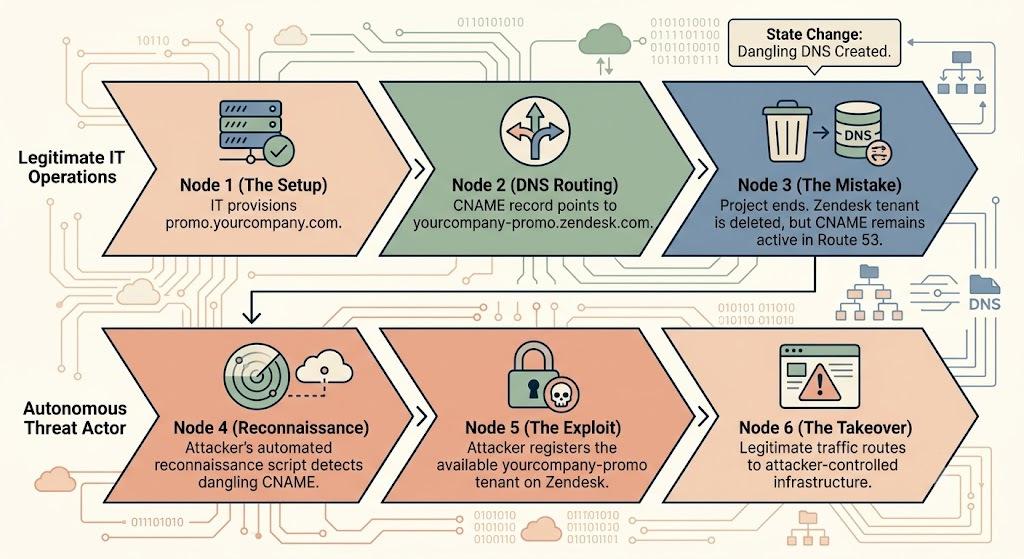
- The Teardown (The Mistake): Six months later, the campaign ends. The Zendesk account is closed to save on licensing costs. However, the IT team forgets to remove the CNAME record from Route 53 or Cloudflare.
- The Exploit: An attacker identifies the dangling record. They create a free Zendesk account and register the tenant name yourcompany-promo.
- The Takeover: Traffic intended for promo.yourcompany.com now routes to the attacker’s Zendesk instance. They have complete control over the content served on a subdomain that carries the organization's trusted SSL certificate and domain reputation.
The Tactical Impact: Moving Beyond Defacement
Red Teamers know that a subdomain takeover vulnerability is rarely just about website defacement. A hijacked subdomain is a highly privileged foothold. It is a skeleton key that bypasses standard perimeter defenses.
Stealing Session Cookies and Bypassing CORS
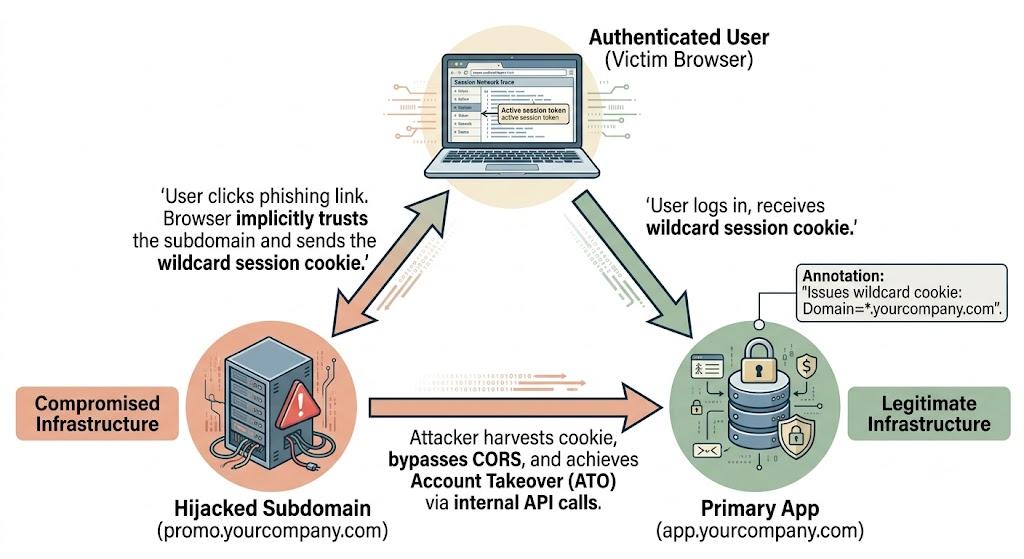
If a primary application at app.yourcompany.com issues authentication cookies scoped to the wildcard domain (*.yourcompany.com), an attacker controlling a hijacked subdomain can harvest those session tokens. When a victim visits the compromised subdomain, their browser willingly hands over the session cookie, leading to immediate account takeover on the main application.
Furthermore, many APIs use wildcard Cross-Origin Resource Sharing (CORS) policies (e.g., trusting *.yourcompany.com). A hijacked subdomain allows an attacker to bypass these restrictions, executing malicious JavaScript to read sensitive data directly from internal APIs.
Highly Credible Phishing and Malware Distribution
Because the subdomain belongs to the root domain, security controls like email filters and web proxies implicitly trust it. Attackers use these domains to host flawless phishing pages to harvest employee credentials or to serve malware payloads that bypass standard endpoint detection blocks.
Why Multi-Cloud Environments Exacerbate the Problem
The transition to multi-cloud architectures has fundamentally fractured visibility. In 2026, a typical enterprise environment isn't just AWS or GCP; it's a sprawling mesh of Azure App Services, AWS S3 buckets, CloudFront distributions, Heroku apps, and dozens of SaaS platforms.
This cloud sprawl leads to severe asset management fatigue. Cloud asset discovery is no longer a localized IT function; it requires parsing configurations across dozens of disparate tenants and APIs. The agility of CI/CD pipelines means resources change state by the minute. When an infrastructure-as-code (IaC) script fails to properly clean up DNS state after tearing down a Kubernetes cluster or an S3 bucket, a dangling DNS record is born.
The Speed of Automated Reconnaissance
Assuming that a forgotten CNAME pointing to an obscure S3 bucket (assets-backup-staging.s3.amazonaws.com) will go unnoticed is a fatal underestimation. Modern adversaries automate everything.
Threat actors deploy massive automated reconnaissance pipelines. They do not manually guess subdomains. They monitor Certificate Transparency (CT) logs in real-time, instantly extracting newly minted subdomains. They use autonomous AI agents to continually brute-force DNS records, utilizing massive distributed botnets to evade rate limits.
The moment a DNS record becomes "dangling," an attacker's script flags it, validates the third-party provider's registration status, and attempts to claim the resource programmatically. This lifecycle from "resource deleted" to "subdomain hijacked" can happen in a matter of hours.
External Attack Surface Management (EASM): The Proactive Defense
Relying on manual DNS audits or point-in-time penetration tests is mathematically insufficient for defending a dynamic multi-cloud perimeter. To secure forgotten infrastructure, organizations must operationalize external attack surface management (EASM).
EASM is the discipline of discovering, monitoring, and evaluating internet-facing assets from an attacker's perspective. However, legacy EASM tools often suffer from the same flaws as legacy scanners: they are noisy, generate false positives, and lack context. Flagging every CNAME as a potential risk creates alert fatigue for Cloud Infrastructure Engineers who are already drowning in SIEM logs.
To be effective, EASM must be offensive, dynamic, and integrated.
Axeploit’s Blueprint for Securing Dangling DNS
Axeploit approaches infrastructure defense with an offensive mindset. Organizations cannot protect a perimeter they cannot see, and they cannot secure a multi-cloud environment without testing it at machine speed. Legacy scanners rely on outdated asset inventories. Axeploit signs up and navigates cloud environments independently, acting exactly like a real attacker.
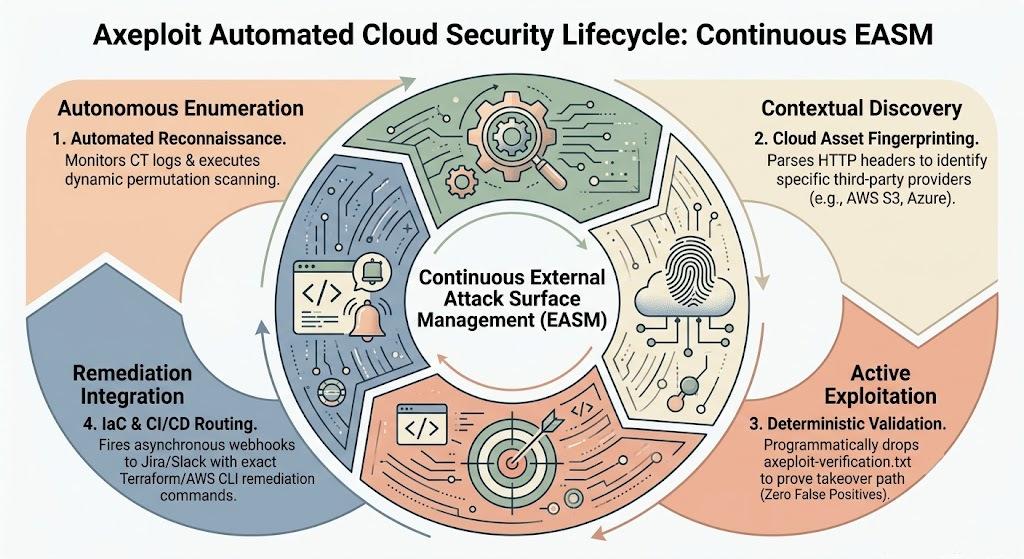
Here is the highly technical blueprint of how Axeploit neutralizes the threat of a subdomain takeover vulnerability through aggressive, continuous monitoring and dynamic exploitation.
1. Autonomous Enumeration and Permutation Scanning (The Recon Engine)
Manual DNS audits are mathematically incapable of keeping pace with modern CI/CD deployments. Axeploit’s agents replace static audits with a continuous, event-driven reconnaissance pipeline.
The enumeration engine does not just query primary authoritative nameservers. It aggressively monitors Certificate Transparency (CT) logs in real-time via Firehose APIs, instantly extracting newly minted subdomains. Concurrently, it runs active permutation scanning. By analyzing existing cloud naming conventions, the AI dynamically generates targeted wordlists (e.g., injecting variables like -stg, -backup, or AWS region codes like -us-east-1 into known hostnames). This massive automated reconnaissance effort utilizes distributed, rate-limit-evading nodes to ensure that even undocumented shadow IT and ephemeral staging environments are brought into full visibility.
2. Contextual Cloud Asset Discovery (Fingerprinting the Mesh)
Finding a subdomain is merely the first step of external attack surface management (EASM). Axeploit goes deeper by mapping discovered external assets directly to the underlying cloud infrastructure.
When a CNAME record is discovered, Axeploit’s agents autonomously analyze the complete DNS resolution chain and the subsequent HTTP response headers (such as x-amz-bucket-region or Server: GitHub.com). By parsing the specific error responses, like an AWS S3 NoSuchBucket XML error, an Azure App Service 404 Web Site not found, or a Fastly Fastly error: unknown domain, the AI fingerprints the exact third-party provider. Because the Axeploit engine continuously scans for over 7,500 known vulnerabilities and misconfigurations, the system understands precisely what conditions and state changes constitute a valid takeover for that specific cloud tenant.
3. Deterministic Validation via Active Exploitation (Zero False Positives)
The most significant failure of legacy EASM tools is alert fatigue; flagging every non-resolving CNAME as a critical risk wastes Red Team and SysAdmin resources.
Axeploit eliminates false positives through deterministic validation. The system does not just alert teams that a dangling DNS record looks suspicious; the agent actively attempts the exploit. If an Azure Traffic Manager profile or an AWS S3 bucket is identified as potentially dangling, the Axeploit engine programmatically interfaces with the respective cloud provider's API. It attempts to register the orphaned namespace and drop a harmless, cryptographic axeploit-verification.txt payload. If the HTTP GET request to the dangling DNS resolves to the verification payload, the takeover is mathematically proven. Security teams receive verified intelligence, not a probabilistic alert.
4. Infrastructure-as-Code (IaC) and CI/CD Integration
A vulnerability is only neutralized when the remediation loop is closed. When Axeploit deterministically proves a takeover path, it generates actionable remediation data tailored for Cloud Infrastructure Engineers.
Instead of generating a generic PDF report, Axeploit fires asynchronous webhooks directly into developer workflows (Jira, Slack, or PagerDuty). The alert includes the exact Terraform state drift context or the specific AWS CLI commands (e.g., aws route53 change-resource-record-sets) required to delete the orphaned DNS record. By integrating this continuous monitoring loop directly into DevOps pipelines, Axeploit ensures that the moment a cloud asset discovery scan flags a destroyed resource, its corresponding DNS footprint is sanitized, closing the window of exposure before an autonomous threat actor can exploit it.
Conclusion
In the 2026 threat landscape, an attack surface is defined not by the assets actively managed, but by the infrastructure left behind. Cloud sprawl and multi-cloud agility have turned dangling DNS into a critical liability. When a subdomain takeover vulnerability is exploited, the attacker inherits hard-earned domain reputation, bypassing perimeters to steal sessions, distribute malware, and pivot into core networks.
Defending against automated adversaries requires an equally automated and relentless defense. Manual audits are dead. Adopting a continuous, offensive EASM strategy is imperative. By utilizing Axeploit to map shadow IT and autonomously validate DNS configurations, organizations ensure that when an infrastructure asset is retired, it stays dead. Reclaim the perimeter before the adversary claims it first.