If you are a Chief Information Security Officer (CISO), a SOC Director, or a Security Architect navigating the financial realities of 2026, you are likely facing an impossible mandate: secure a rapidly expanding, highly dynamic cloud perimeter while simultaneously slashing vendor bloat.
Executive boards and CFOs are demanding aggressive CISO budget optimization, yet compliance frameworks and the escalating threat landscape require more vigilance than ever. For years, the default response to compliance and security validation has been the traditional, manual penetration test. But in the era of automated CI/CD pipelines and AI-driven cybercrime, this legacy approach is bleeding your budget dry.
It is time to abandon the point-in-time snapshot. This article provides a comprehensive operational and financial breakdown of transitioning to Continuous Threat Exposure Management (CTEM) using AI agents, and how doing so can reduce your security testing costs by up to 80%.
The Hidden Financial Drain of Traditional Pentesting
To understand the pentest ROI of autonomous systems, we first have to look at why manual testing has become fundamentally economically unviable for modern development speeds.
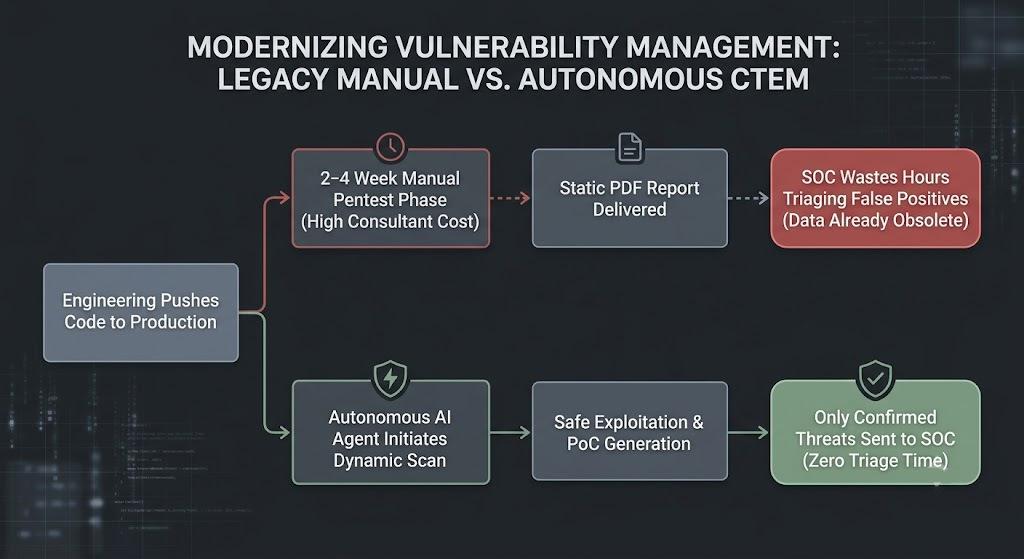
A traditional penetration test is a point-in-time snapshot. You hire a highly-paid team of consultants, they spend two to four weeks poking at your staging environment, and they hand you a static PDF report.
The financial and operational flaws here are massive:
- The Velocity Gap: By the time that PDF report lands on your desk, your engineering teams have likely pushed dozens of new microservices and code commits to production. You just paid a premium rate for data that is already obsolete.
- Consultant Premiums: You are paying high hourly rates for human testers to run basic reconnaissance and routine vulnerability scans before they even get to the complex, manual exploitation phase.
- The Hidden Cost of Triage: Traditional testing and legacy automated vulnerability scanning tools notoriously generate massive lists of theoretical vulnerabilities. Your highly paid SOC analysts and security engineers must then waste hundreds of hours manually verifying these alerts to separate true risks from false positives.
Transitioning to Continuous Threat Exposure Management (CTEM)
To break this cycle, forward-thinking security leaders in 2026 are adopting Continuous Threat Exposure Management (CTEM). CTEM is a framework that shifts security from an annual compliance checkbox to an active, ongoing process.
However, implementing CTEM manually is impossible without ballooning your headcount. This is where AI penetration testing bridges the gap.
Automated PoC Generation: The End of False-Positive Chasing
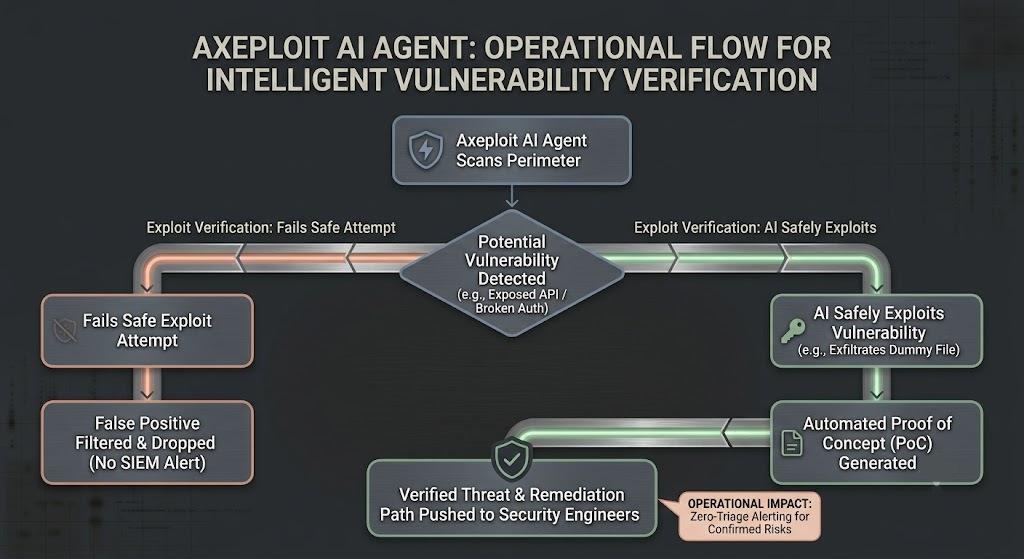
The true breakthrough in modern AI security agents isn't just that they can scan your perimeter faster, it is that they can autonomously validate the threat.
When an AI agent identifies a potential weakness, it does not just throw an alert into your SIEM for a human to investigate. Instead, it safely exploits the vulnerability in real-time, generating an automated Proof of Concept (PoC). If the agent successfully exfiltrates a dummy file or bypasses an authentication layer, the threat is undeniable.
This completely eliminates the hidden costs of manual triage. Your SOC team only spends time fixing confirmed, exploitable vulnerabilities, effectively giving you back thousands of hours in lost productivity.
Calculating the Cybersecurity ROI Metrics for 2026
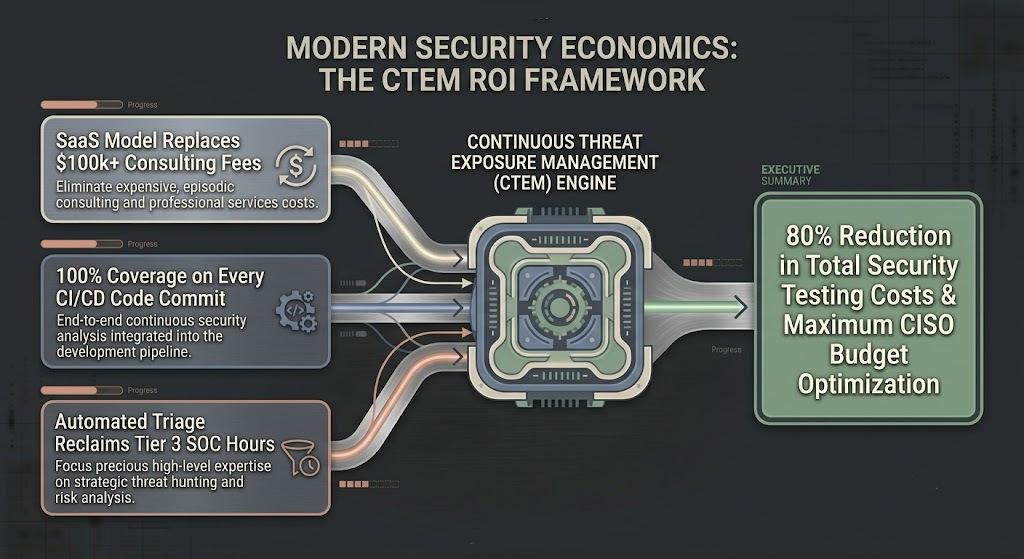
When we evaluate the cybersecurity ROI metrics of moving to an autonomous testing platform, the 80% cost reduction becomes highly tangible. Here is the financial breakdown:
1. Eliminating Recurring Consulting Fees
Instead of paying $30,000 to $100,000+ for quarterly manual pentests, an autonomous AI testing platform operates via a predictable software-as-a-service (SaaS) model. You get 24/7/365 testing for a fraction of the cost of a single manual engagement.
2. Zero-Cost Continuous Security Validation
In a CI/CD environment, every code deployment introduces new risk. Continuous security validation means your applications are automatically attacked and tested from the outside, exactly like a hacker would every single time a change goes live. You achieve 100% coverage across your release cycles without adding a single dollar to your testing budget.
3. Reclaiming SOC and Engineering Hours
The most expensive asset in your security department is human capital. By using automated PoC generation to eliminate false positives, you free your Tier 3 analysts and Security Architects to focus on high-level threat hunting, architecture hardening, and strategic initiatives, rather than chasing ghosts in the network.
Why Axeploit is the Ultimate ROI Multiplier
You cannot outsource your security architecture to an outdated methodology, and you certainly cannot afford to stall your development pipelines waiting for a manual security review.
Axeploit is designed specifically for the realities of the modern, high-velocity enterprise. Axeploit bridges the gap between rapid development and robust DevSecOps by continuously scanning your live applications and uncovering shadow attack surfaces before malicious actors can exploit them.
Our dynamic, AI-driven engine doesn't just read your static configurations; it actively and safely probes your live external perimeters, web applications, and APIs. When Axeploit finds an exposure, it flags the exact exploit path and provides your platform engineering team with clear, actionable remediation insights to patch the vulnerability at the source.
Conclusion: Security Validation That Pays for Itself
In 2026, the era of paying premium consulting rates for obsolete, point-in-time snapshots is officially over. The mandate to "do more with less" is no longer a temporary squeeze; it is a permanent reality for modern security departments. CISOs simply cannot afford to balance high-velocity cloud development with slow, manual security checks that drain the budget and delay deployment.
By embracing autonomous AI agents for your offensive security, you aren't just checking a compliance box, you are fundamentally transforming your pentest ROI. Transitioning to continuous security validation allows you to cut external testing costs by up to 80%, eliminate the operational drag of false-positive triage, and present a flawless, data-backed case for CISO budget optimization to your board.