As a Chief Information Security Officer (CISO), Security Operations Center (SOC) analyst, or cloud security engineer, you know that defending the perimeter is no longer enough. The real battleground in 2026 has shifted to the complex web of third-party integrations that connect your enterprise applications. The recent breach of the market intelligence platform Klue serves as a stark reminder of this reality. In this incident, a relatively new extortion group known as "Icarus" leveraged a compromised OAuth integration to quietly steal Salesforce CRM data from multiple organizations.
This wasn't a smash-and-grab attack involving ransomware or zero-day exploits. It was a calculated supply chain compromise that exploited the inherent trust placed in authorized software-as-a-service (SaaS) integrations. Let's break down exactly how this breach unfolded, how the attackers operated, and the critical steps you must take to ensure your organization doesn't become the next victim on the Icarus data leak site.
Anatomy of the Breach: A Trusted Integration Turned Malicious
Klue is a popular platform that provides competitive intelligence, seamlessly syncing "battlecards" (quick reference documents for sales teams) with CRM systems like Salesforce. Because it needs to pull and push sales data, the Klue app requires broad access to an organization's Salesforce environment, authenticated via OAuth tokens.
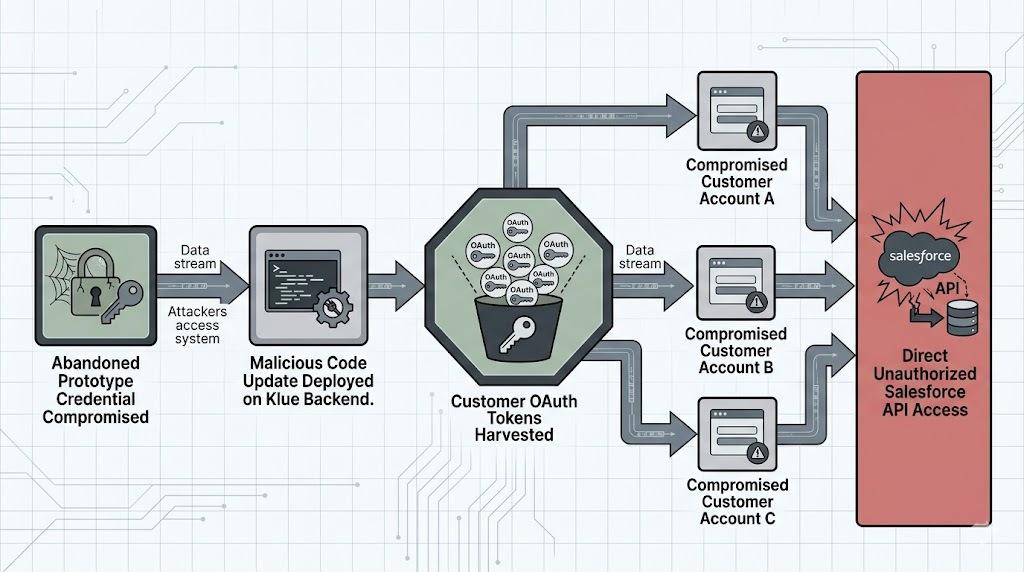
According to incident reports from cybersecurity firms like Huntress and ReliaQuest, the compromise began on June 11, 2026. The threat actors initially gained access to Klue's backend infrastructure by exploiting a long-dormant but still active credential. This credential was originally created for a third-party prototype integration that Klue had long since abandoned.
Once inside, the attackers didn't try to steal Klue's proprietary data. Instead, they pushed a malicious code update designed to harvest the OAuth tokens that Klue's customers used to connect the platform to their own systems. Armed with these stolen tokens, the attackers could now authenticate directly into the Salesforce instances of Klue's enterprise customers, bypassing traditional login portals and multi-factor authentication (MFA) entirely. From Salesforce's perspective, the malicious logins looked exactly like legitimate traffic from the trusted Klue integration.
The Extortion Playbook: Enter the Icarus Threat Group
The group behind this attack, tracking under the moniker "Icarus," has been active since April 2026. Their methodology in the Klue incident demonstrates a high degree of technical sophistication and patience, echoing the tactics of notorious data-theft groups like UNC6395 and ShinyHunters.
Here is how they executed the data extraction:
- Reconnaissance via REST APIs: Using automated Python scripts (identifiable by specific Python-urllib user-agent strings in the logs), the attackers first queried the Salesforce REST API endpoint /services/data/v59.0/sobjects.
- Slow Mapping: For hours, they slowly mapped out the structure of the victims' Salesforce environments, identifying valuable custom objects and standard records without triggering rate limits or volume-based alarms.
- Rapid Exfiltration: Once the most lucrative data was identified, the attackers shifted tactics. Using the /services/data/v59.0/query endpoint, they initiated a massive, concentrated data extraction. In one observed instance, they executed nearly a thousand queries in just 15 minutes, pulling massive volumes of CRM data before moving on.
By the time Klue detected the anomaly on June 12 and began revoking tokens, the damage was done. Huntress, a Klue customer itself, confirmed that the stolen data included highly sensitive business contacts, price quotes, and sales messaging. Fortunately, no engineering telemetry, passwords, or payment card information was compromised.
Following the exfiltration, victims began receiving extortion emails directing them to a Session Messenger ID corresponding to the Icarus group, threatening to publish the stolen records on their dark web leak site. In response, Salesforce completely disabled the Klue Battlecards integration on its platform to stop the bleeding, while Klue suspended its connections to other platforms like HubSpot, Zoom, and Google Drive.
Step-by-Step Guide: How to Secure Your SaaS Integrations Against OAuth Attacks
If your organization utilizes Klue, or any third-party app with deep API access, assuming your perimeter is secure is a dangerous fallacy. OAuth abuse is a repeatable, highly effective playbook that bypasses traditional identity controls. Here is a step-by-step remediation and hardening guide for SOC analysts and security managers to implement immediately.
Step 1: Revoke and Rotate All OAuth Tokens
Simply changing a service account password is not enough. OAuth access relies on tokens, not passwords.
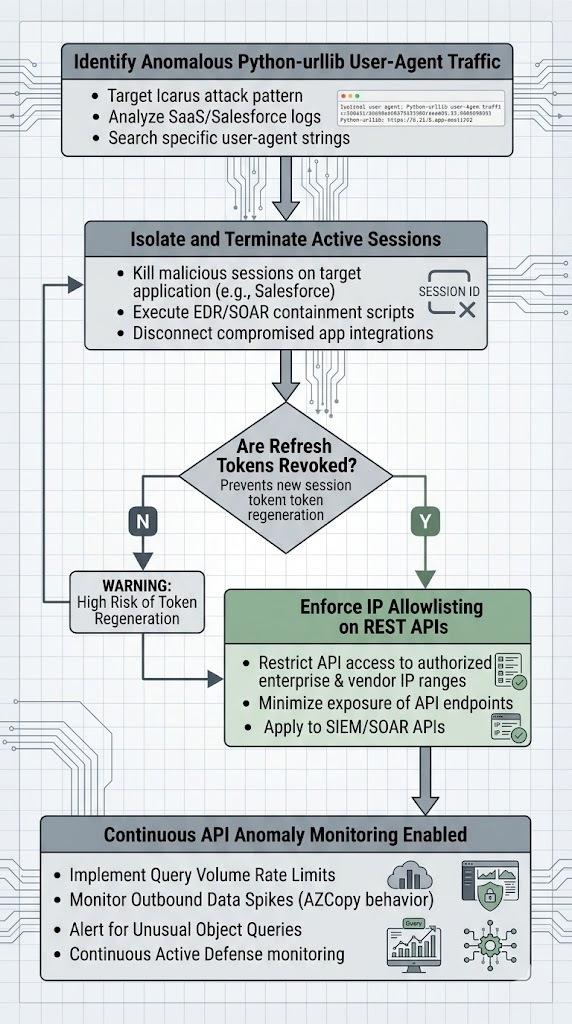
- Revoke Active Sessions: Immediately terminate all active sessions connected to the affected integration.
- Rotate Refresh Tokens: You must revoke the OAuth refresh tokens. If an attacker holds a valid refresh token, they can simply generate a new access session even after a password reset.
- Audit Permissions: Re-evaluate the integration's scope. Does the application genuinely need access to all CRM objects, or can you apply the principle of least privilege?
Step 2: Hunt for Malicious API Activity
Your SOC team needs to aggressively query your SaaS and SIEM logs for specific Indicators of Compromise (IoCs).
- Identify the User Agent: Search your Salesforce REST API logs for automated traffic utilizing the Python-urllib user-agent.
- Monitor Query Volume: Look for sudden, massive spikes in queries directed at /services/data/v59.0/sobjects and /services/data/v59.0/query. A burst of hundreds of queries within a short window (e.g., 15 minutes) is a massive red flag.
- Cross-Reference IP Addresses: Review access logs for IP addresses that deviate entirely from the vendor's known infrastructure footprint.
Step 3: Enforce API Restrictions and IP Allowlisting
Leaving your APIs open to the public internet, even if they require authentication, is a massive risk.
- Restrict by IP: Lock down API access for third-party integrations to known, allow-listed vendor IP addresses. If an OAuth token is stolen, the attacker won't be able to use it from their own infrastructure.
- Secure Security Tools: Apply the exact same IP restrictions to your SIEM and SOAR (Security Orchestration, Automation, and Response) APIs so that requests originating from outside approved corporate networks are instantly blocked and alerted.
Breaking the Cycle: Active Defense with Axeploit
The Klue incident highlights a fundamental flaw in modern cybersecurity hygiene: the "forgotten" access point. The initial breach occurred because a long-abandoned prototype credential was left active on a backend system. Access brokers and extortion groups like Icarus rely heavily on these blind spots such as misconfigurations, forgotten APIs, and legacy integrations that slip through the cracks during routine audits.
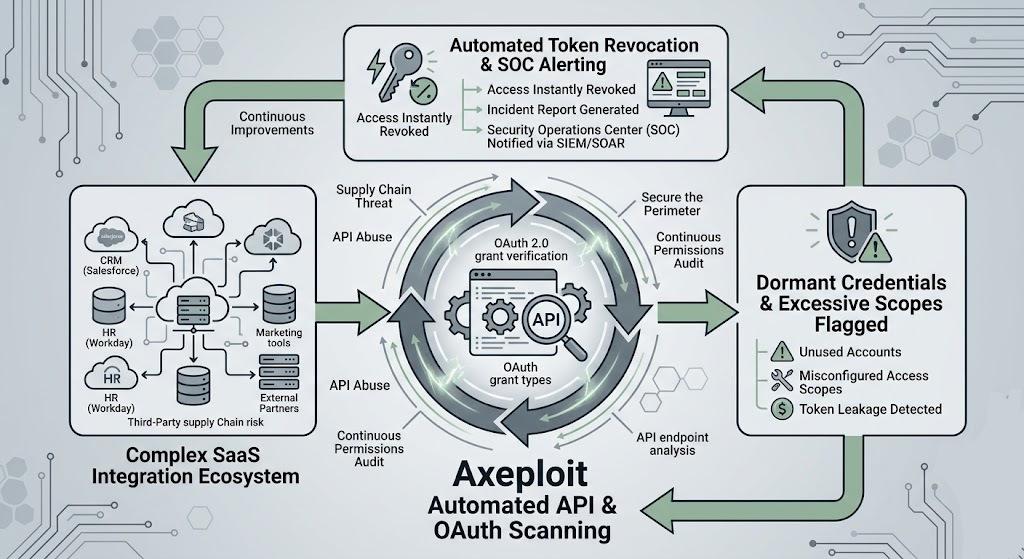
This is exactly where passive security checklists fail and active defense must take over. Axeploit fundamentally bridges this gap by acting as an automated dynamic scanner that views your enterprise perimeter exactly how a threat actor views it.
Instead of waiting for an attacker to stumble upon a dormant credential or an over-permissioned OAuth app, Axeploit continuously and safely probes your live environment. It maps your entire attack surface, including complex SaaS integrations and undocumented API endpoints. If your development team leaves an unauthenticated administrative panel exposed, or if a legacy integration remains active with broad OAuth scopes, Axeploit's dynamic engine will flag the vulnerability immediately.
By providing clear, actionable remediation insights to your SOC and platform engineering teams, Axeploit allows you to sever the exploit path long before an extortion group can deploy a Python script to siphon your data. You cannot defend what you cannot see, and in the era of interconnected SaaS ecosystems, continuous active testing is the only way to stay ahead of the supply chain threat.
Conclusion
The operational sophistication of the Icarus group and their successful compromise of the Klue platform serves as a critical warning for 2026. The traditional network perimeter has dissolved, replaced by a sprawling ecosystem of API connections and OAuth permissions. When threat actors can turn the very tools designed to enhance business productivity into conduits for massive data exfiltration, the rules of engagement must change.
Defending against this evolving threat landscape requires CISOs and security managers to rethink their approach to third-party trust. You must assume that any integrated vendor can be compromised. By strictly enforcing least privilege, aggressively hunting for API anomalies, rotating refresh tokens, and deploying continuous active defense platforms like Axeploit, you can sever the cybercrime supply chain and ensure your critical CRM data remains firmly out of the hands of extortionists.