Ask any DevOps engineer, platform engineer, or lead developer what slows down release velocity, and you will hear a familiar story: security testing. Security teams demand comprehensive, deep scanning across every layer of the application, while development teams need fast, uninterrupted builds to keep shipping features. When heavy, legacy SAST and DAST tools are shoehorned directly into the build pipeline, the result is predictable; mounting developer friction, high false-positive noise, and CI/CD pipelines grinding to a halt.
It doesn’t have to be this way. Modern DevSecOps CI/CD integration is shifting away from synchronous, build-blocking security gates. By leveraging zero-config scanners powered by autonomous AI agents, organizations can perform deep dynamic security testing on staging environments concurrently, without delaying deployments by a single second. Here is how you can transform security from a release bottleneck into an automated, developer-friendly process that provides verified, locally reproducible Proof of Concepts (PoCs).
The Flaw in Traditional "Shift Left Security"
The security industry spent the last decade preaching the doctrine of shift left security. The core promise made sense: catch vulnerabilities early in the development lifecycle before code hits production, reducing remediation costs and risk. However, the practical execution of this concept created severe friction across engineering teams.
When traditional tools were retrofitted into automated pipelines, they brought legacy overhead with them. Static Application Security Testing (SAST) tools analyze source code, but they notoriously flood developers with false positives, flagging non-exploitable code patterns that require manual triage.
On the other hand, embedding traditional DAST in CI/CD presented an even tougher operational hurdle. Legacy dynamic scanners require tedious setup:
- Hardcoding user credentials or complex auth tokens into test environments.
- Manually recording brittle browser login flows and navigation scripts.
- Maintaining static API lists that break every time an endpoint schema changes.
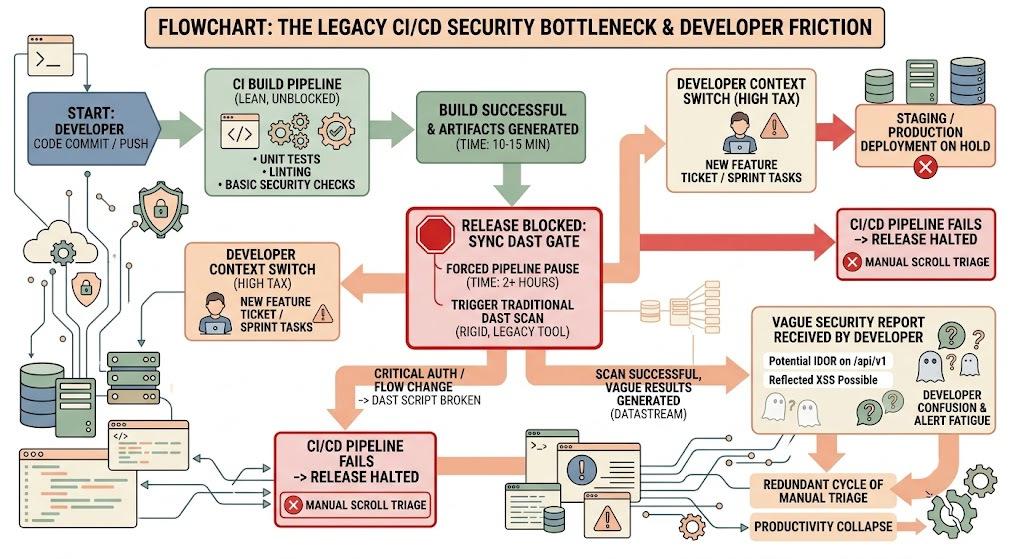
If a developer updates a frontend component or adds a multi-factor authentication step, the legacy scanner breaks, failing the entire pipeline build. Instead of writing features, developers end up spending hours debugging broken test scripts.
Why Synchronous Build-Blocking is Dead
Forcing CI/CD pipelines to wait synchronously for a multi-hour security scan fundamentally breaks continuous integration. Continuous delivery relies on rapid feedback loops,ideally under 10 to 15 minutes. When a pull request triggers a two-hour DAST run before code can be merged, developer momentum collapses.
By the time the scanner finishes its run and generates a report, the developer has already switched contexts to work on another ticket. If the build was blocked due to a false positive or an auth script failure, the context switch back to the original PR incurs a heavy productivity tax.
Decoupling deployment from security scanning is the key to breaking this bottleneck. The goal of modern platform engineering is to maintain lightning-fast deployment velocity while ensuring that thorough security testing happens continuously in the background.
The Era of Autonomous, Zero-Config Scanners
To eliminate setup overhead and maintenance burdens, modern security testing relies on autonomous AI agents rather than rigid static scripts. Modern zero-config scanners, such as Axeploit, approach dynamic vulnerability scanning from the perspective of an active human penetration tester rather than a passive pattern matcher.
Instead of requiring pre-recorded auth scripts or shared admin credentials, autonomous AI agents handle complex authentication workflows natively:
- Self-Registration & Authentication: AI agents sign up for new accounts independently, manage their own mobile OTP verifications, handle email confirmation links, and track OAuth/SSO flows.
- Layout-Aware Intelligence: If your team updates a frontend framework, renames UI buttons, or changes page layouts, the autonomous agent adapts in real time without breaking its exploration path.
- Dynamic API & Asset Discovery: The agent discovers endpoints, hidden parameters, and unlinked web routes automatically, identifying vulnerabilities across more than 7,500 known vectors—including complex business logic flaws and IDOR (Insecure Direct Object Reference) vulnerabilities that legacy tools consistently miss.
Because these agents operate without manual configuration or API schema uploads, platform teams can onboard new microservices and applications in seconds by simply pointing the agent to the application's target URL.
Implementing Asynchronous DevSecOps CI/CD Integration
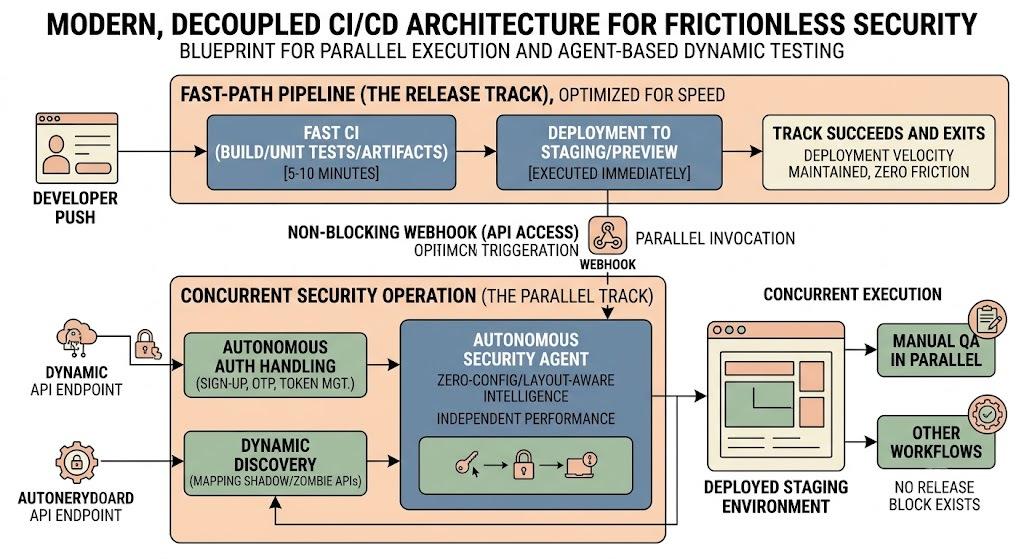
Achieving frictionless DevSecOps CI/CD integration requires structuring security scans as asynchronous, event-driven workflows rather than synchronous, build-blocking gatekeepers. For platform engineers, the goal is zero friction: developers commit code, pipelines execute unit tests, and robust security scans occur autonomously without delaying the release cadence.
Here is the technical blueprint for implementing concurrent security testing in a modern CI/CD pipeline using advanced, zero-config DAST solutions like Axeploit:
1. Optimize the Fast-Path CI Pipeline
The core pull-request build must remain exceptionally lean. Platform engineers should limit inline blocking checks in the CI runner (like GitHub Actions, GitLab CI, or Jenkins) to fast-executing tasks: unit tests, essential linter rules, and dependency audits (e.g., checking for known CVEs in npm or pip modules). The objective is to compile valid code, generate the artifact, and push it to a staging or ephemeral preview environment in minutes.
2. Event-Driven Invocation via Webhooks and API Access
Instead of embedding a monolithic scanner directly into the pipeline job, modern integration relies on decoupled execution. Once the staging deployment successfully spins up, the CI system fires a lightweight, non-blocking webhook to the autonomous security platform.
Using robust API access, the pipeline programmatically triggers the scan by passing the target URL of the newly deployed staging environment. The CI job immediately exits with a success status, allowing the PR to be merged or the developer to move to their next task. There is no waiting for the scan to finish; the integration is entirely asynchronous.
3. Deploying Private Scanning Models and On-Prem Architectures
For enterprise environments with strict data residency or compliance requirements, executing SaaS-based scans against internal staging servers isn’t always feasible. Advanced DevSecOps platforms solve this by offering private deployments of their AI scanning models.
By utilizing on-prem or VPC setups, organizations can run the AI agent's inference engine directly within their own network boundaries. The pipeline triggers the internal scanner, which then targets the protected staging environment without external ingress requirements, ensuring data never leaves the corporate perimeter while maintaining autonomous scanning capabilities.
4. Smart Scan Control and Granular Targeting
Traditional tools often force a full-site crawl, which wastes time and resources. Modern integration leverages "Smart Scan Control" to target only what matters. Through the API payload, platform engineers can instruct the LLM engine to focus the scan on specific URLs, newly deployed features, or high-risk endpoints.
The AI-powered LLM configures the scan parameters dynamically without manual setup, ensuring the agent exercises the newly deployed code rather than re-scanning legacy assets that haven't changed.
5. Concurrent Autonomous Execution
Once triggered, the zero-config agent operates concurrently in the background. It handles its own authentication by automatically signing up for test accounts, receiving OTPs on its own mobile numbers, and managing session tokens natively. Because it possesses layout-aware intelligence, frontend DOM changes will not break its exploration path. It probes the staging environment for over 7,500 known vulnerabilities, including complex business logic flaws, while the environment remains fully accessible for parallel manual QA testing.
6. Streamlined Real-Time Notification and Remediation
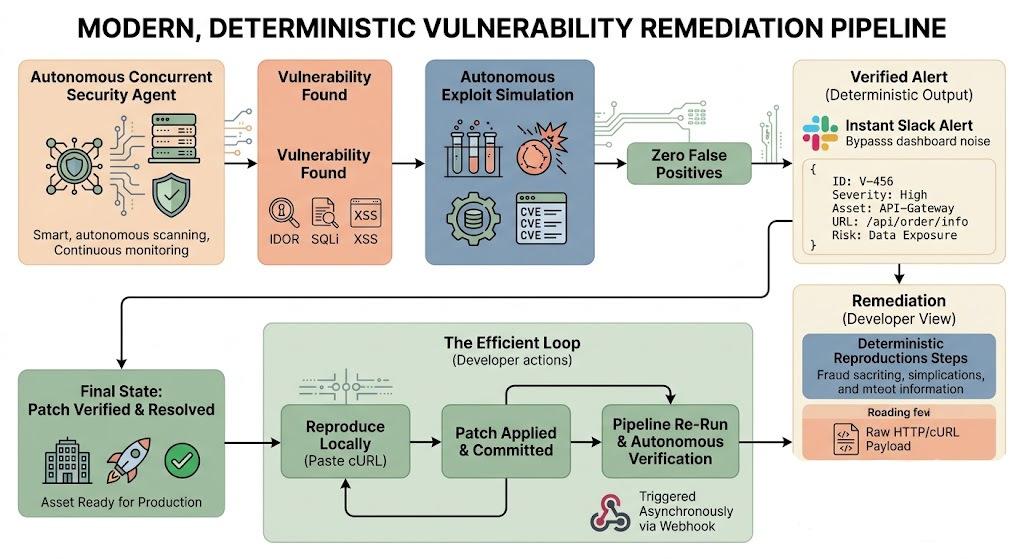
When a vulnerability is verified, the agent does not silently append it to a monolithic dashboard. Utilizing API webhooks, the platform pushes instant Slack notifications directly to the responsible engineering channel. These alerts bypass traditional alert fatigue by delivering verified Proof of Concepts (PoCs), complete with exact payloads and HTTP requests, allowing developers to reproduce and patch the vulnerability locally before it ever reaches production.
Pain-Free Vulnerability Remediation with Verified PoCs
As any seasoned engineer will tell you, alert fatigue is fundamentally a data problem, one that is actively burning out security and development teams alike. The biggest contributor to developer friction isn't the act of fixing bugs; it is the sheer volume of unverified, contextless alerts generated by legacy SAST and DAST tools. When developers are handed a generic warning like "Potential Cross-Site Scripting on /api/v1/user", they are forced to spend hours guessing the context, setting up local reproduction environments, and testing payloads, only to frequently discover it was a false positive.
The Authentication Blind Spot
Legacy vulnerability scanners rely heavily on rigid signatures and predefined state files, making them exceptionally poor at navigating modern applications. By design, these traditional tools are unable to detect deep-seated issues such as email verification failures, mobile OTP problems, and weak tokens. This is a massive blind spot, considering that authentication flaws cause over 30% of all vulnerabilities. If a security tool cannot properly manage a session token lifecycle or navigate flawed OAuth and SSO implementations, it will never reach the authenticated endpoints where the most critical business logic flaws reside.
How Autonomous Exploit Simulation Changes the Game
Modern zero-config solutions like Axeploit flip this paradigm by operating exactly like a human attacker. Equipped with layout-aware intelligence, the AI agent handles authentication natively. With its own mobile number and email address, the agent can register, verify, and log in, just like any legitimate user.
Because it genuinely interacts with the application, the agent can map out complex microservice architectures and uncover hidden attack surfaces, including undocumented shadow APIs and deprecated zombie APIs. By testing actual server-side validation against frontend assumptions, the agent scans for over 7,500 known vulnerabilities, spanning from complex Insecure Direct Object References (IDOR) to sophisticated authentication bypasses.
Actionable Data: The Verified Proof of Concept
When an autonomous agent discovers a vulnerability, it doesn't just flag a regex match; it actively exploits it using a constantly refreshed CVE intelligence database,which includes zero-days, and an extensive database of fuzzing patterns. Consequently, the platform delivers a Verified Proof of Concept (PoC).
Instead of a vague alert, developers receive a highly technical, actionable payload delivered directly via instant Slack notifications. This payload includes:
- Deterministic Reproduction Steps: The exact sequence of events required to trigger the exploit, eliminating guesswork.
- Raw HTTP/cURL Payloads: Clean, copy-pasteable cURL commands containing the exact headers, malformed session tokens, or injected parameters used to exploit the endpoint.
- Contextual Impact Analysis: Clear explanations of the underlying flaw (e.g., failure in business logic, unsecured endpoints, or weak authentication mechanisms).
- Custom Report Exports: Detailed findings can be exported as PDFs using branded templates, making it easy to share verified audits with stakeholders.
By providing deterministic, locally reproducible proof, modern security tooling transforms abstract security warnings into standard, easily patchable engineering tickets. Developers spend less time chasing ghosts and more time writing secure, robust code.
Conclusion
Unlocking rapid release velocity while maintaining a rock-solid security posture is no longer a trade-off you have to make. The historical friction between security teams and engineering teams was never caused by mismatched goals, it was caused by legacy security tools forced into modern delivery pipelines.
By modernizing your DevSecOps CI/CD integration with zero-config scanners, you eliminate the maintenance overhead and brittle configurations of legacy tools. Transitioning to asynchronous, concurrent testing in staging allows developers to ship code instantly while autonomous AI agents handle the heavy lifting of deep vulnerability testing in the background. Most importantly, replacing false-positive clutter with verified, locally reproducible PoCs streamlines vulnerability remediation into standard, predictable engineering tasks.