If you are a Chief Information Security Officer (CISO), a Security Operations Center (SOC) analyst, or a security manager navigating the threat landscape of 2026, you already know that the image of a lone-wolf hacker coding in a dark basement is a dangerous myth. Today, cybercrime operates like a massive, transnational corporate conglomerate. You are no longer defending your network against isolated, independent threat actors; you are defending against highly integrated criminal ecosystems.
Recent threat intelligence has exposed deep, undeniable links between two major ransomware operations: Interlock and Rhysida. This convergence reveals a chilling new reality. Modern ransomware groups are increasingly abandoning the traditional, siloed Ransomware-as-a-Service (RaaS) models. Instead, they are actively sharing malware source code, leveraging unified cloud infrastructure, and purchasing network entry points from the exact same access brokers. By pooling their technical resources, these syndicates are accelerating their attack velocities, maximizing their profits, and bypassing traditional network perimeters with terrifying efficiency.
The Anatomy of a Ransomware Syndicate: Interlock and Rhysida
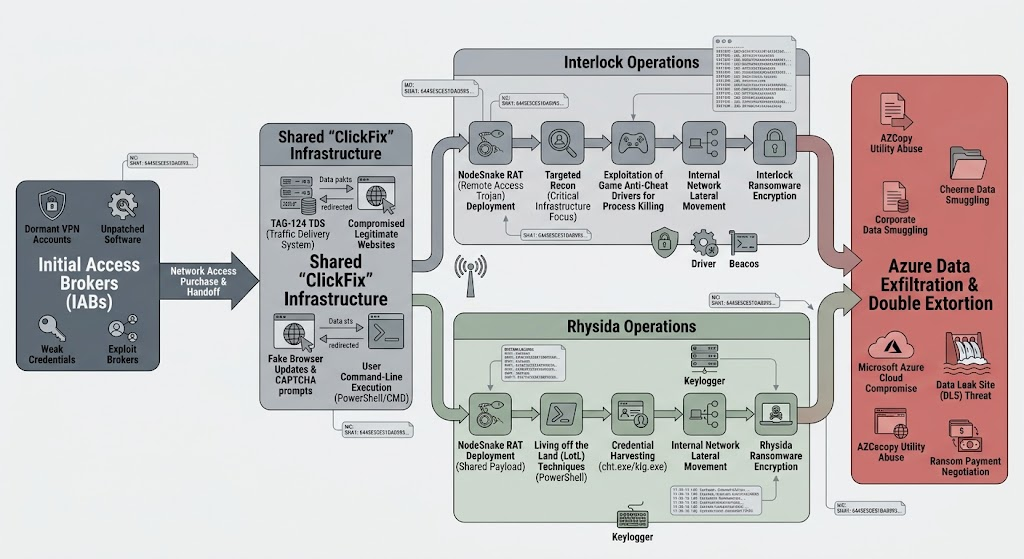
To understand how to defeat these intertwined threats, we must first understand how they collaborate. Interlock, a stealthy ransomware group initially observed deploying highly targeted attacks against critical infrastructure, was previously thought to be a completely standalone entity. However, detailed forensic tracking in 2026 has proven that Interlock’s operations heavily overlap with the notorious Rhysida ransomware gang. Instead of building everything from scratch, these groups utilize a shared cybercrime supply chain.
Here is an inside look into how their shared ecosystem operates:
Unified Initial Access Brokers (IABs)
Instead of spending weeks breaking into enterprise networks themselves, ransomware groups now outsource the heavy lifting. IABs are specialized hackers who exclusively focus on finding weak points—like dormant VPN accounts or unpatched software. Once an IAB breaks in, they sell that "open door" on the dark web. Both Interlock and Rhysida are actively purchasing access from the same high-level brokers, drastically cutting down their time-to-infection. In 2026, threat hunters have actively observed both syndicates utilizing initial payloads like MintLoader delivered through shared TAG-124 Traffic Delivery System (TDS) infrastructure.
The "ClickFix" Social Engineering Trap
Both cartels heavily utilize a shared technique known as "ClickFix." Rather than sending a traditional malicious email attachment (which modern email filters easily block), attackers compromise legitimate websites to display fake error messages, such as a fake Google Chrome browser update or a fraudulent CAPTCHA verification. These messages instruct the user to press a sequence of keys (often "Windows + R", then "Ctrl + V"). This tricks the user into manually pasting and executing malicious commands directly into their computer’s terminal. Because the user manually executes the command, traditional anti-virus software assumes it is a legitimate action.
Shared Malware and Persistence Tools
Once inside, the ecosystem relies on shared tools like the "NodeSnake RAT" (Remote Access Trojan). A RAT acts as an invisible backdoor, granting the hacker full remote control over the infected machine. Furthermore, NodeSnake is built using JavaScript and Node.js, allowing it to bypass traditional security scanners that only look for malicious executable files.
They also employ "Living off the Land" techniques, meaning they use your computer's built-in, legitimate administrative tools (like PowerShell) to move around the network, blending in perfectly with normal, daily IT traffic. To ensure their malware survives, these actors have even begun deploying process-killing tools that abuse zero-day vulnerabilities in legitimate PC gaming anti-cheat drivers to effectively blindside modern endpoint protection agents.
Cloud-Based Exfiltration and Double Extortion
Before locking your systems with encryption, both Interlock and Rhysida practice "Double Extortion." This means they steal your highly sensitive corporate data first, threatening to leak it publicly on the dark web if you refuse to pay the ransom. In their shared playbook, both groups abuse legitimate Microsoft Azure cloud utilities, specifically tools like AZCopy, to rapidly smuggle your data out of your network undetected.
Indicators of Compromise (IoC) to Watch For
To proactively defend against this cartel convergence, your SOC needs precise, actionable data. Update your SIEM rules and EDR blocklists with the following 2026 Indicators of Compromise associated with the shared Interlock and Rhysida ecosystem:
- Malicious Scripts & Payloads: Be highly vigilant for obfuscated JavaScript implants. Specifically, flag the SHA1 hash 6445E5CE51DA03934395ABB5411D3200D12ED7B3, corresponding to k4myle3i.dll, which acts as an advanced iteration of the Interlock/NodeSnake RAT.
- Post-Exploitation Executables: Monitor endpoints for the presence or execution of cht.exe (a specialized credential stealer) and klg.exe (a persistent keylogger) often dropped in the startup directory.
- Network Anomalies: Hunt for outbound beaconing to known TAG-124 TDS domains, which are predominantly used to host the malicious CAPTCHA prompts that funnel victims into the ClickFix pipeline.
- Process Terminations: Investigate any sudden or unexplained termination of your native antivirus or EDR services, particularly if the event logs indicate the recent installation of .sys driver files associated with video game anti-cheat engines.
Step-by-Step Guide: How to Stay Safe from the Shared Ransomware Ecosystem
Because these cartels use legitimate cloud tools and manipulate your own employees into bypassing security controls, relying on traditional passive firewalls is a recipe for disaster. Here is a step-by-step guide for CISOs and SOC analysts to fortify enterprise environments against the Interlock and Rhysida syndicates:
Step 1: Neutralize "ClickFix" and Initial Access Traps
Your first line of defense must focus on preventing the execution of malicious commands by unwitting employees.
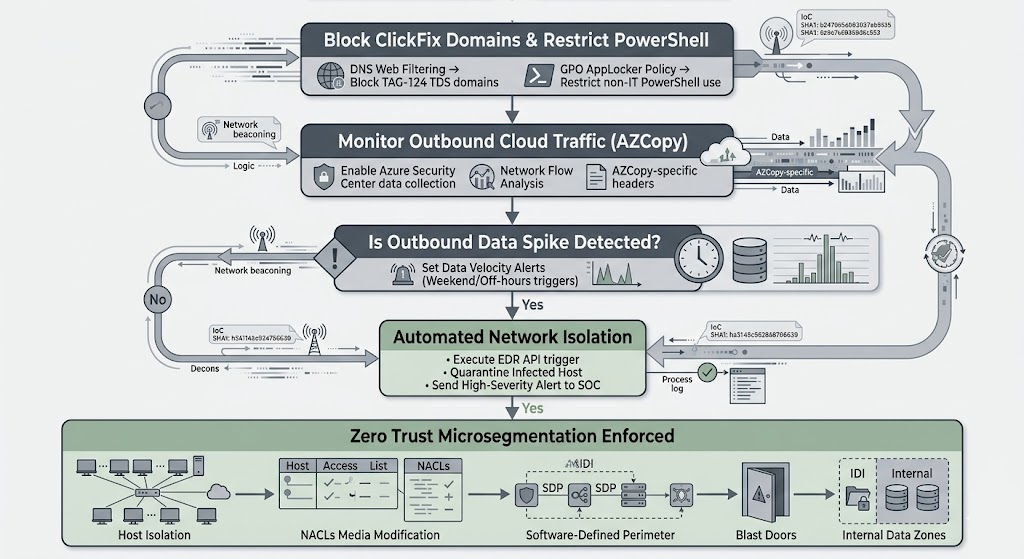
- Restrict Execution: Implement strict application control and execution policies. Prevent regular business users from opening command-line interfaces (like PowerShell or the Command Prompt) unless it is explicitly required for their daily role.
- Filter Traffic Intelligently: Deploy advanced DNS web filtering to instantly block access to newly registered domains and known compromised sites, which are the primary hosting grounds for fake ClickFix browser updates.
Step 2: Monitor and Block Cloud Exfiltration Channels
If attackers cannot steal your data, their double extortion leverage is completely destroyed.
- Block Legitimate Tool Abuse: Enforce strict outbound traffic filtering. Unless your business architecture specifically requires massive data uploads to external Azure storage blobs, flag and outright block the use of administrative tools like AZCopy or Azure Storage Explorer by unauthorized accounts.
- Set Data Velocity Alerts: Configure your Security Information and Event Management (SIEM) systems to trigger high-priority alerts for sudden, massive spikes in outbound data transfers, especially if they occur during weekends or off-hours.
Step 3: Enforce Strict Least Privilege and Zero Trust
As a security manager, you must assume that an Initial Access Broker will eventually bypass your perimeter and compromise an employee's laptop.
- Limit Authority: Enforce the principle of "Least Privilege," ensuring every single user, application, and service account only has the absolute bare minimum network access required to function.
- Isolate Through Architecture: Implement internal microsegmentation. Divide your internal network into small, tightly controlled zones. If a hacker breaches a workstation in the HR department, microsegmentation acts like a series of locked blast doors, preventing the attacker from moving laterally into your critical patient databases or financial servers.
Step 4: Harden Your Active Directory and Identity Providers
- Secure the Perimeter: Mandate phish-resistant Multi-Factor Authentication (MFA) across the entire organization, placing a strict emphasis on securing remote VPNs and administrative portals.
- Prune Dead Accounts: Conduct continuous audits of your active directory to identify, isolate, and disable dormant or inactive user accounts. Unmonitored legacy accounts are prime targets for IABs looking to establish a quiet, persistent backdoor.
Breaking the Kill Chain: What You Can Do Now With Axeploit
Locking down your internal network policies is highly critical, but it only secures the theoretical architecture. What happens when a sophisticated, shared malware strain slips through the cracks, or an overworked IT administrator accidentally leaves an internal API endpoint exposed to the public internet? This is where passive, static defense ends, and active testing must begin.
Axeploit fundamentally bridges the gap between static compliance checklists and real-world threat resilience. Initial Access Brokers make their money by continuously scanning the internet for forgotten misconfigurations and unpatched vulnerabilities. Instead of waiting for these brokers to find a flaw and sell it to the Interlock or Rhysida cartels, Axeploit’s automated dynamic scanner gets there first.
Axeploit does not just read your configuration files; it actively and safely attacks your live environment from the outside, perfectly mimicking the exact reconnaissance and exploitation behaviors of modern ransomware syndicates. If your platform engineering team accidentally deploys a web application with an unauthenticated administrative panel, or if your network perimeter is susceptible to the exact vulnerabilities these cartels actively exploit, Axeploit’s dynamic engine will instantly catch it.
We flag the exposed exploit path and provide your SOC analysts and developers with clear, actionable remediation insights to patch the vulnerability at the source, long before a malicious actor can weaponize it.
Conclusion: Disrupting the Cybercrime Supply Chain
The operational merger of groups like Interlock and Rhysida marks a dark, highly professionalized evolution in global cybercrime. By freely sharing malware, leveraging unified cloud infrastructure, and utilizing centralized access brokers, these syndicates are operating at a scale and velocity that human defenders simply cannot match using outdated, manual techniques.
For CISOs, SOC analysts, and security managers, surviving this modern threat landscape requires abandoning the illusion of a perfectly safe perimeter. You must build your infrastructure assuming that attackers will inevitably try to trick your employees, abuse your legitimate administrative tools, and hunt relentlessly for forgotten misconfigurations. By enforcing a Zero Trust architecture, heavily restricting outbound data flows, and integrating continuous, automated dynamic testing into your daily operations, you can aggressively disrupt the cybercrime supply chain before the attack even begins.