If you are a Backend Architect, DevOps Engineer, or an AppSec professional operating in 2026, you know that securing a modern cloud-native application is a game of immense scale. We spend heavily on perimeter defense. We deploy next-generation Web Application Firewalls (WAFs), implement strict rate limiting, and route all North-South traffic through heavily fortified API gateways.
We lock the front door with a deadbolt. But what happens once someone slips past the bouncer?
In too many organizations, the internal network remains a trusted zone. Once a request makes it past the API gateway, it is assumed to be legitimate. This “hard shell, soft center” design is exactly what modern threat actors are looking for. We are diving into how attackers exploit implicit trust boundaries between microservices, how unrestricted east-west traffic facilitates devastating lateral movement, and how to enforce true Zero Trust architecture at the code level.
The Fallacy of the Trusted Internal Network
For years, development teams skipped implementing internal authentication. The justification was usually speed: requiring internal microservices to constantly authenticate with one another adds latency, complicates the CI/CD pipeline, and frustrates developers.
As a result, an architecture emerged where the API Gateway handles all external auth (validating JWTs, checking scopes) and then strips those headers, passing naked, unauthenticated requests to the backend services.
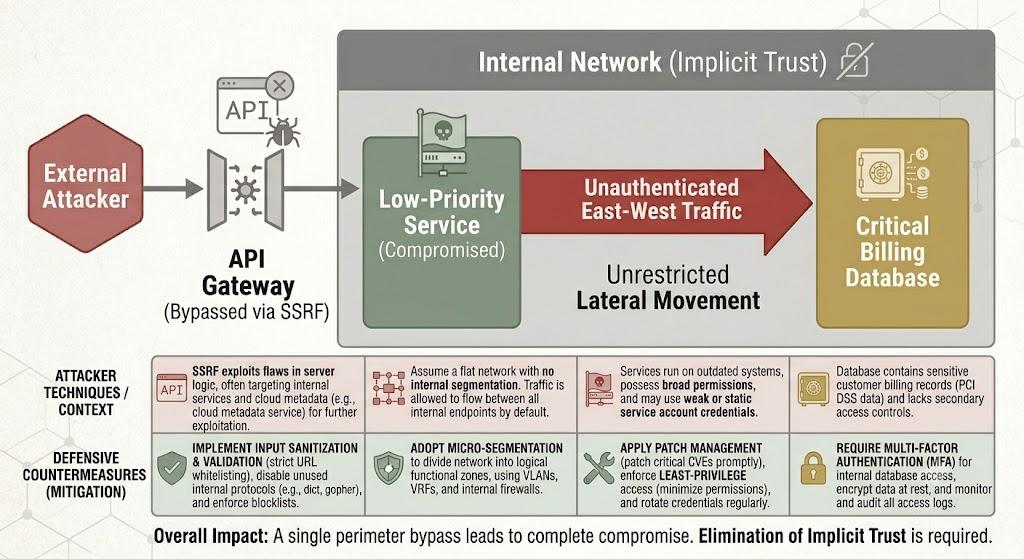
This means your billing microservice inherently trusts your user-profile microservice simply because they share the same Kubernetes namespace or virtual network.
Anatomy of an East-West Breach
In a distributed environment, attackers do not need to breach your most critical database directly. They only need to find a single, low-priority edge service with a minor vulnerability, perhaps a forgotten, deprecated API endpoint or an SSRF (Server-Side Request Forgery) flaw in a PDF generation service.
Once the attacker gains a foothold in that low-priority container, the perimeter is irrelevant. They map the internal network and begin moving laterally. Because the east-west traffic (service-to-service communication) is completely unmonitored and implicitly trusted, the compromised PDF generator can simply send a direct REST call to the internal financial microservice, extracting sensitive data or altering records without triggering a single perimeter alarm.
Enforcing True Zero Trust Architecture
To stop this chain reaction, the industry has shifted toward a foundational rule: Zero Trust architecture. Zero Trust mandates that no entity, whether outside or inside the network is trusted by default. Every single request, even one originating from an adjacent pod in the same cluster, must be continuously authenticated, authorized, and encrypted.
But how do you implement this without forcing your developers to write complex API security logic into every single microservice?
Enter the Service Mesh
By mid-2026, attempting to manage internal microservice authentication manually is a fool's errand. Instead, elite DevOps teams deploy a Service Mesh like Istio or Linkerd.
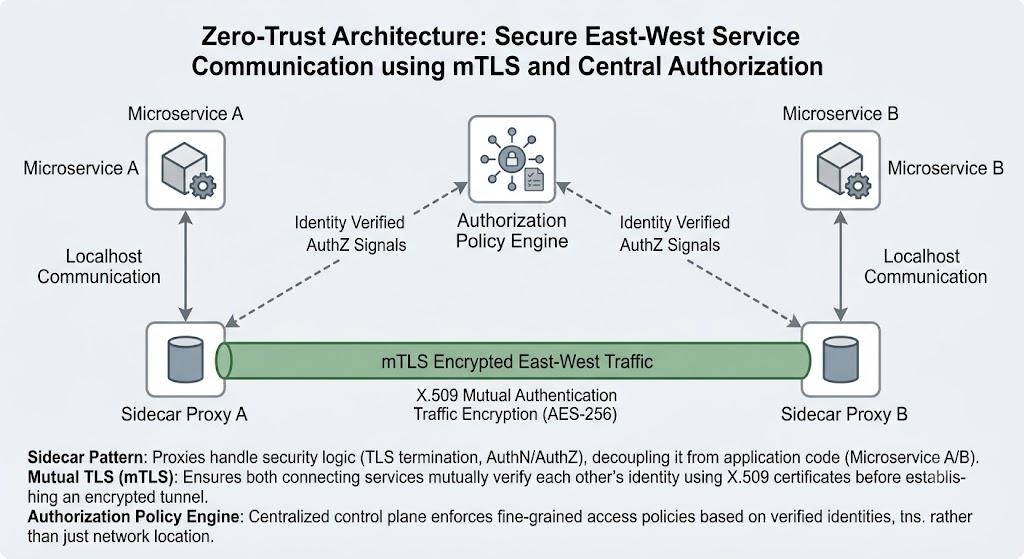
A service mesh decouples the security logic from the application code by injecting a "sidecar proxy" next to every single microservice. When Service A wants to talk to Service B, it doesn't communicate directly. Instead:
- Service A talks to its local sidecar.
- Service A's sidecar establishes a mutually authenticated TLS (mTLS) connection with Service B's sidecar.
- Service B's sidecar checks the cryptographic identity of the caller against a centralized policy engine.
- Only if the policy explicitly allows the connection does the traffic reach Service B.
This completely neutralizes network-based lateral movement. Even if an attacker compromises a container, they cannot communicate with any other service unless an explicit, least-privilege policy permits it.
Configuration is the New Attack Surface
Implementing a service mesh is a massive leap forward, but it is not a silver bullet. As we migrate security from the network layer to the configuration layer, the attack surface simply shifts.
If a platform engineer accidentally deploys an Istio AuthorizationPolicy with a wildcard (*) verb, or if a newly spun-up service bypasses the mesh proxy due to a mislabeled Kubernetes deployment, your Zero Trust architecture instantly collapses back into implicit trust. And because these configurations look perfectly valid on paper, traditional static code analysis (SAST) tools will rarely flag them.
Active Defense: Validating Your Microservices
You cannot assume your internal network is secure just because you deployed a service mesh. You must physically validate that your trust boundaries are holding up under pressure.
This is where the Axeploit API Security Checker becomes the ultimate safety net for your DevSecOps pipeline.
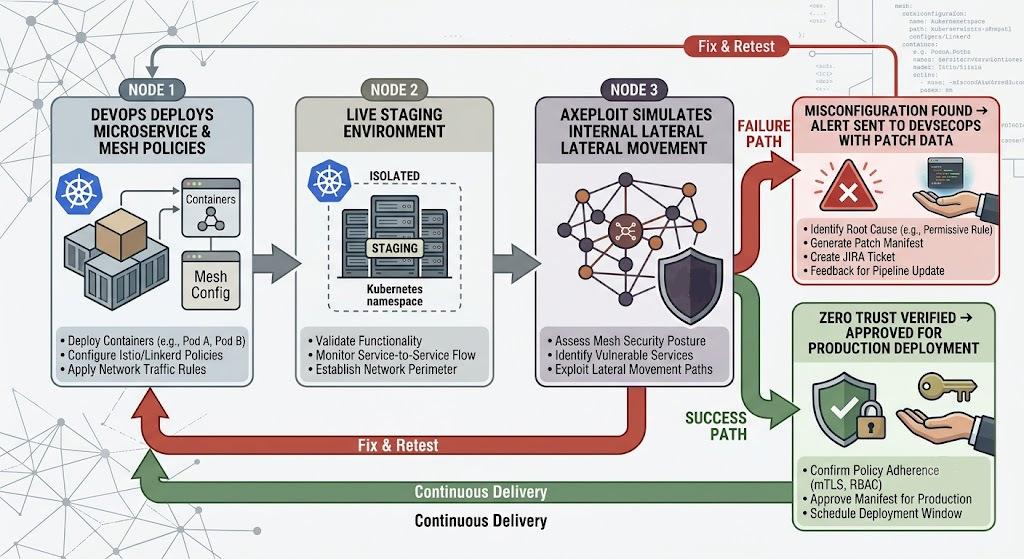
While static tools guess at what your configurations might do, Axeploit actively attacks your live, running environment from the inside out. Our automated dynamic vulnerability scanner simulates the exact behavior of a breached container attempting lateral movement. Axeploit tests your internal APIs, probes your east-west traffic corridors, and safely attempts to bypass your service mesh policies.
If a developer accidentally exposed an internal administrative endpoint without requiring a valid mTLS token, Axeploit’s dynamic engine will immediately discover it. We flag the exposed exploit path and provide your AppSec team with precise, actionable remediation insights to lock down the vulnerability before a threat actor exploits it.
Conclusion: Zero Trust is a Continuous Journey
The era of the “hard shell, soft center” network is completely over. As we have seen, relying solely on an API gateway leaves your organization vulnerable to rapid lateral movement. Once attackers bypass the perimeter, they weaponize the implicit trust of your east-west traffic to compromise critical databases without ever sounding an alarm.
To neutralize these threats, organizations must shift their focus to the individual microservices. By implementing a robust service mesh and enforcing a strict zero trust architecture, you effectively build a fortress around every single container.
However, because this shifts the security burden to complex configuration files, continuous dynamic testing is the only way to prove your API security policies are actually holding up under pressure. Securing your internal network shouldn't slow down your deployment cycles. You need active, automated defenses like Axeploit that validate your infrastructure from the inside out.