If you are a SOC Analyst, an Incident Responder, or a SOC Manager standing on the front lines of defense in 2026, you know the daily reality of the job: the flashing red dashboard never sleeps. Every day, your team is bombarded by thousands of critical notifications. You are expected to parse logs, verify context, and neutralize threats at machine speed.
But there is a glaring problem that the industry has swept under the rug for years. Most of those “critical” alerts are complete noise.
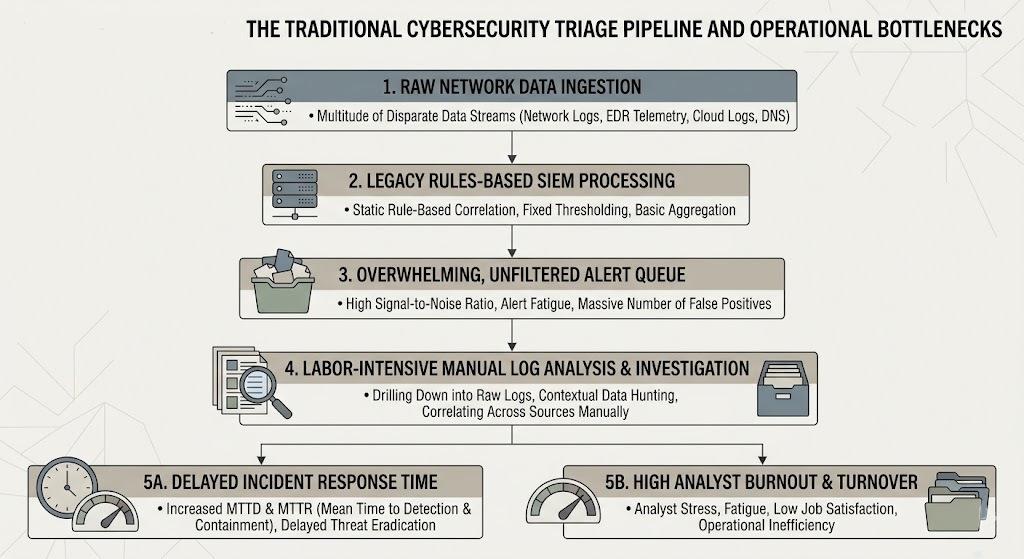
Traditional Security Information and Event Management (SIEM) systems and rigid correlation rules have left modern security teams completely drowning in false positives. Instead of hunting for actual threat actors, brilliant analysts spend their valuable hours closing repetitive tickets generated by benign network anomalies. The result? Severe alert fatigue, burnout, and the terrifyingly high probability that a real, sophisticated breach will be missed amidst the chaotic noise.
The era of manual, click-and-drag triage is unsustainable. To survive the velocity of modern cyberattacks, we must pivot from manual review to autonomous alert validation. By deploying a specialized fleet of AI security agents, we can independently investigate alerts, correlate telemetry, and allow human analysts to focus strictly on confirmed, high-severity threats.
The Root of the Chaos: Why Legacy SIEMs Fail
To solve the crisis in the Security Operations Center, we must first diagnose why the traditional framework is broken. Legacy SIEM systems rely on static correlation rules. These rules are essentially complex “If-This-Then-That” statements designed by engineers to catch anomalies. For example: If a user logs in from two distant geographic locations within an hour, trigger a critical alert.
While this looks good on paper, it completely fails to account for the reality of modern, distributed cloud computing. A developer switching on a VPN while running an automated script can trigger a wave of high-severity alerts.
Because traditional systems lack the ability to understand real-time context, they treat routine behavioral shifts as immediate threats. This creates a massive triage bottleneck. Every single alert requires a human analyst to manually open the ticket, pull endpoint logs, query identity access management databases, check network traffic, and determine the legitimacy of the event. When an individual analyst has to repeat this loop hundreds of times per shift, their cognitive load peaks, drastically increasing the Mean Time to Resolution (MTTR).
Enter the Fleet: How AI Security Agents Investigate Threats
The solution to alert fatigue is not to hire more analysts to handle the manual workload; the solution is SOC automation driven by intelligent, autonomous systems. In 2026, the blueprint for a modern security architecture relies on an orchestrated fleet of specialized AI security agents.
Unlike basic automation scripts that simply execute a fixed sequence of commands, autonomous AI agents are capable of dynamic reasoning. They don't just notice that an anomaly occurred, they independently ask the follow-up questions required to validate it.
Cross-Network Telemetry Correlation
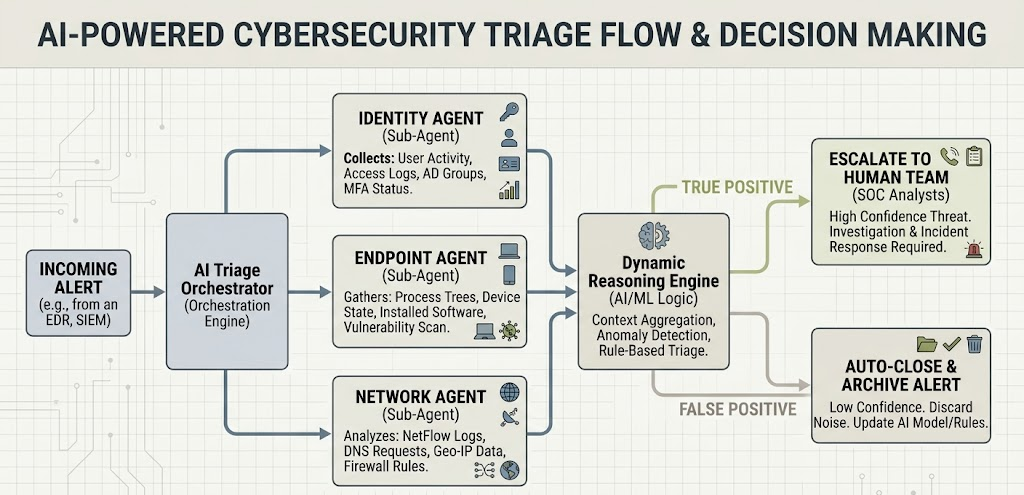
When an alert triggers, an autonomous triage agent immediately takes over the preliminary investigation. It maps out the entire context of the event by querying diverse data streams across your infrastructure:
- Endpoint Insights: The agent checks the host's Endpoint Detection and Response (EDR) telemetry to see what specific processes were running when the alert occurred.
- Identity Context: It queries identity providers to analyze the user's historical behavioral baseline, checking if this action aligns with their standard responsibilities.
- Network Artifacts: It analyzes the destination IP addresses, checking domain reputation scores and verifying if the outbound traffic matches known command-and-control configurations.
By independently executing this deep investigation in seconds, the AI agent can determine whether an event is a dangerous intrusion or a completely harmless false positive. If it is a false positive, the agent automatically closes the ticket, logs the context for future reference, and silences the noise before it ever reaches a human dashboard.
A Framework for Transitioning to an Autonomous SOC
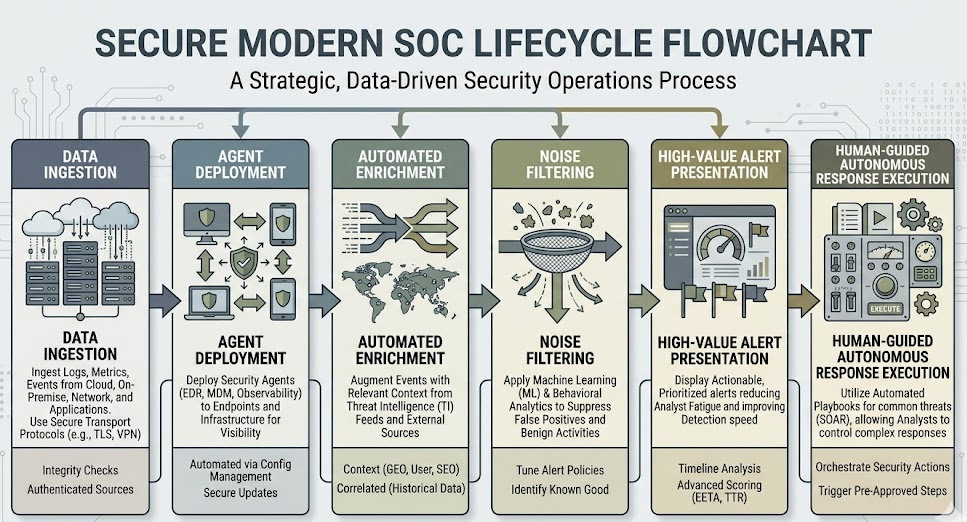
Moving your team from a manual, chaotic triage state to a streamlined, autonomous response model doesn't happen overnight. It requires a structured engineering framework that balances machine-speed execution with strategic human oversight.
Step 1: Ingestion and Event Normalization
Your autonomous agents are only as good as the data they can access. You must aggregate your logs from cloud environments, identities, internal APIs, and networks into an open data fabric. Ensure your storage layers allow your agents to run lightning-fast semantic searches and structure queries without causing performance lag.
Step 2: Agent Orchestration and Playbook Guardrails
Deploy specialized agents trained for distinct investigative domains (e.g., an email security agent, a cloud configuration agent, a malware analysis agent). Define the precise boundaries of their autonomy using flexible guardrails. For example, allow the agent to independently gather data, execute enrichment, and auto-archive lower-severity anomalies, while reserving remediation actions on production infrastructure for explicit validation.
Step 3: Closing the Loop and Shrinking MTTR
When the AI fleet detects a confirmed, high-severity threat, it doesn't just hand over a raw notification. It presents the incident responder with a comprehensive timeline: the verified entry point, the affected systems, the extracted indicators of compromise (IoCs), and a recommended remediation strategy. This cuts out hours of manual research, shrinking your MTTR from days to minutes.
The Axeploit Edge: Proactive Defense Meets Intelligent Operations
Building a resilient, autonomous SOC requires defense-in-depth. While autonomous triage networks work tirelessly from the inside to filter telemetry and catch lateral movement, the most effective way to eliminate alert fatigue is to shrink your external attack surface entirely. If your public endpoints, web applications, and APIs are completely secure, they simply won't generate the chaotic waves of security events that flood your internal SIEM.
This is exactly where Axeploit steps in.
Axeploit’s automated vulnerability scanner and dynamic API checker complement your automated SOC by acting as your ultimate proactive line of defense. Instead of waiting for an attacker to trigger an internal log notification, Axeploit continuously and safely attacks your live, running environments from the outside, exactly like an advanced cybercriminal would.
By identifying exposed endpoints, logical flaws, and access control vulnerabilities before production, Axeploit allows your software developers and engineers to patch security gaps before they can ever be weaponized. When you eliminate vulnerabilities at the source, you permanently block the initial access vectors used by hackers, cutting off the threat at the root and drastically reducing the volume of raw alerts your internal SOC has to monitor.
Conclusion: Reclaiming the SOC with Intelligent Automation
The traditional, reactive model of security monitoring is officially broken. Expecting human analysts to manually parse through thousands of false positives generated by rigid systems is a recipe for operational failure and catastrophic data exposure.
By embracing autonomous alert validation, leveraging specialized AI fleets, and establishing an aggressive, proactive security posture, organizations can finally defeat alert fatigue. Let your machines handle the machine-speed noise, so your elite threat hunters can focus on what matters most: outsmarting the real adversary.