Let’s be honest with each other. If you are reading this, you are likely an AppSec Engineer, a Penetration Tester, or a Security Architect. You know the score. You spent weeks tuning your Web Application Firewall (WAF), creating custom regexes, and optimizing OWASP CRS rules. Your dashboard shows thousands of blocked SQLi payloads and XSS strings, and you feel, perhaps, a temporary sense of security.
But in the back of your mind, you know there’s a dead zone. You know that while your WAF is busy high-fiving itself for blocking <script>alert(1)</script>, an attacker is calmly draining user data or manipulating inventory by sending perfectly formatted, 100% legitimate-looking JSON requests. The uncomfortable truth of 2026 is that legacy WAFs, regardless of how "next-gen" they claim to be, are fundamentally blind to business logic vulnerabilities. They look at the syntax, but they cannot understand the story. This technical deep dive explains why that is, how attackers are exploiting it, and why active, AI-driven behavioral testing is your only path forward.
The Signature Trap: The Mechanics of Legacy Boundary Defense
To truly understand why a WAF is blind to logic flaws, we must perform a microscopic analysis of its inspection engine. Historically, web application security has relied on perimeter control. Regardless of deployment mode, whether as an inline reverse proxy, a Transparent Bridge, or a Cloud-WAAP (Web Application and API Protection) edge integration, legacy WAFs primarily utilize a negative security model based on a deterministic, per-request inspection at Layer 7.
This paradigm hinges entirely on static, pre-defined knowledge of known malicious payloads.
The Normalization and Tokenization Pipeline
When an HTTP request hits the WAF, the pipeline begins with protocol validation and normalization. The WAF must deconstruct the Layer 7 traffic, decoding various formats (e.g., percent-encoding in URLs, HTML entities, base64 blobs, or multi-part form data) and canonicalizing path segments to prevent evasion techniques.
Once normalized, the request is tokenized; parsing the method, headers, parameters, and body into discrete fields. The core inspection engine then applies a massive, combinatorics-heavy ruleset, typically consisting of thousands of Regular Expressions (regexes), such as those found in the OWASP Core Rule Set (CRS).
Why Decoupled Inspection Fails Semantics
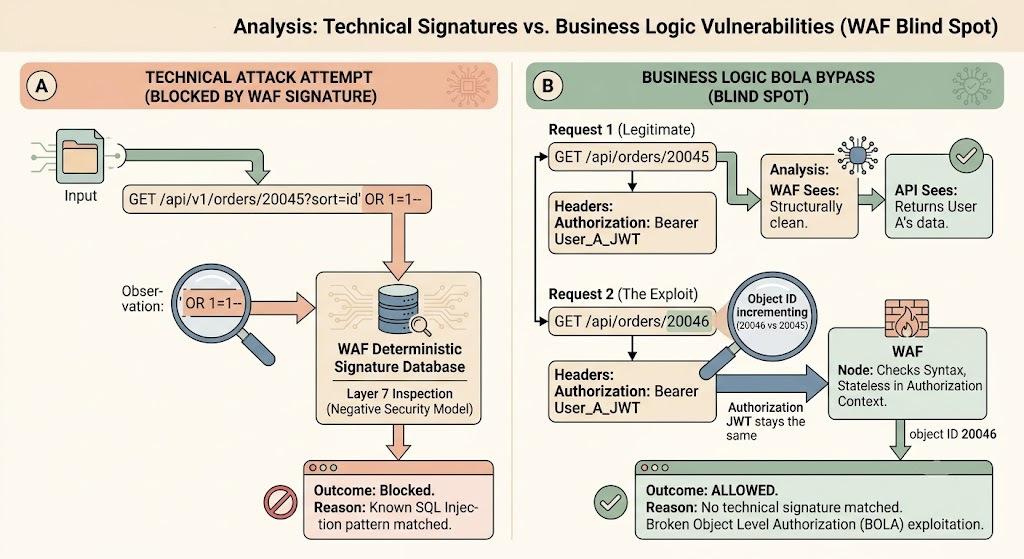
This is where the fundamental engineering dead end lies. These regex rules are atomic, decoupled checks. A WAF can match <script>alert(1)</script> to an XSS rule because it is analyzing the syntactic structure of that specific input. However, it cannot, by its very architecture, validate semantic intent.
A legacy WAF is fundamentally stateless regarding the internal business logic of the protected application. It maintains the state of the network connection (TCP/TLS), but it does not maintain the state of a user’s interaction with the application state machine. It has no context regarding the expected sequence of operations. For example, it does not know that calling POST /api/v1/checkout should be prerequisites by calls to POST /api/v1/cart/add and POST /api/v1/shipping/select.
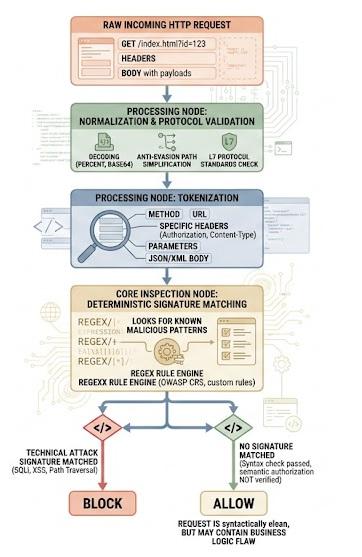
By inspecting traffic purely on a per-request basis (stateless inspection at the application layer), rather than per user session lifecycle (behavioral monitoring), the legacy WAF makes a foundational error: it assumes that if a request looks structurally and syntactically valid, the user's intent and the subsequent server-side processing are also valid. A logic flaw exploitation, by definition, uses structurally valid requests to abuse intended functionality.
The Anatomy of a WAF Bypass via Business Logic
Let’s get technical. How are sophisticated attackers achieving a high-frequency WAF bypass in 2026? They are shifting their focus away from technical injection flaws toward manipulating the intended flow of the application.
If your application allows a user to update their profile via POST /api/v1/user/update, a traditional WAF will check the JSON body for typical injection payloads. If the payload is just {"email": "new-attacker@axeploit.com", "role": "admin"}, the WAF sees a valid JSON object and permits it. The WAF has no way of knowing that allowing a standard user to change their "role" parameter is a catastrophic failure of the authorization logic.
The Rise of the BOLA Exploit (formerly IDOR)
By mid-2026, Broken Object Level Authorization (BOLA), historically known as Insecure Direct Object Reference (IDOR), remains the #1 vulnerability in API environments. An attacker performs systematic IDOR testing by manipulating identifiers in REST API endpoints to access data that isn't theirs.
Consider this scenario:
Request 1 (Legitimate User View):GET /api/orders/20045Headers: Authorization: Bearer [User_A_Token]
The application returns Order 20045, which belongs to User A.
Request 2 (Attacker Manipulation - A BOLA Exploit):GET /api/orders/20046Headers: Authorization: Bearer [User_A_Token]
Here, User A (the attacker) simply increments the ID to request an order belonging to User B.
Why does the WAF see nothing wrong?
- Protocol Compliance: The request is valid HTTP.
- Authentication Present: A valid, non-expired JWT is included.
- No Injection Payload: 20046 is a perfectly legal integer.
The WAF cannot see that User A's token shouldn't match Object ID 20046. The WAF is stateful in terms of the network session, but it is stateless in terms of the application’s intended access control logic.
Why Your API Security Posture Requires Application Context
The shift towards microservices and the absolute ubiquity of APIs have only compounded this problem. Legacy WAFs excel at monolithic boundary defense, but they struggle with the complex, distributed context of modern APIs. An optimal API security posture in 2026 requires understanding the interplay between different API endpoints.
Business logic is often spread across multiple API calls, forming a unique behavioral baseline for legitimate users. A WAF inspecting requests one by one is blind to logical sequences.
Parameter Pollution and Pricing Manipulation
Think about an e-commerce checkout flow. An attacker might use HTTP Parameter Pollution to bypass client-side logic that isn't enforced strongly on the server.
Legitimate Request: POST /checkoutPayload: item=axe_scanner&quantity=1&price=499
WAF Bypass via Parameter Abuse: An attacker discovers that the server processes the last instance of a parameter.
POST /checkoutPayload: item=axe_scanner&quantity=1&price=499&price=0.01
Client-side JavaScript might generate the request, but a proxy tool (like Burp or OWASP ZAP) allows the attacker to inject the second price parameter. The WAF inspects the full payload, finds that 0.01 is not a SQL command, and lets it pass. The server, due to flawed parsing logic, accepts the 0.01 price, and the attacker checks out for a penny. Again, the WAF is syntactically happy but semantically blind.
Moving Beyond Signatures: AI-Driven Behavioral Testing
We must stop expecting a boundary device using static signatures to solve application-level semantic problems. The signature-matching era is over. The only way to find business logic vulnerabilities before attackers do is through active, aggressive, and AI-driven behavioral testing.
This is where the Axeploit paradigm shifts. While boundary defense has its place, true resilience requires proactively finding behavioral anomalies.
The Axeploit Approach to Logic Flaw Discovery
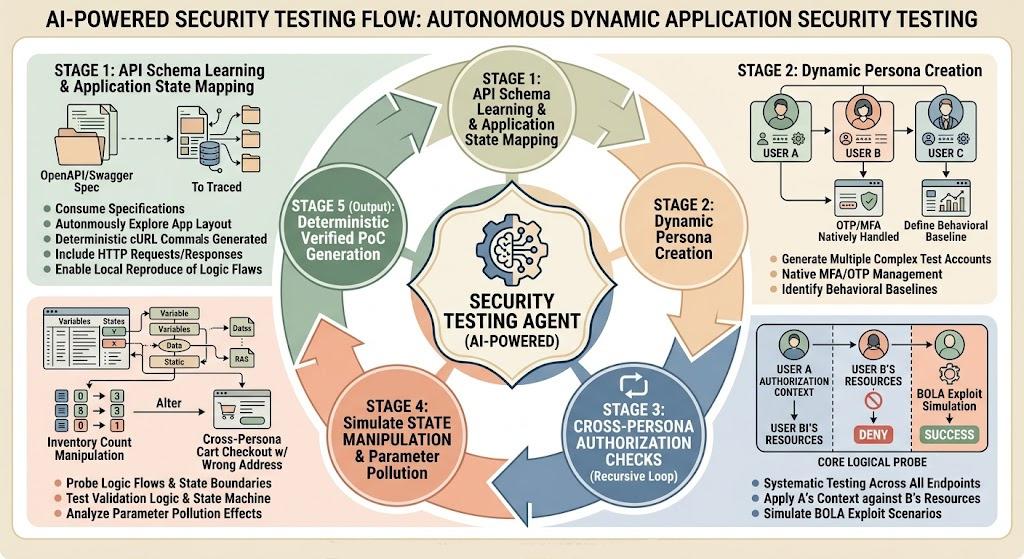
Modern DevSecOps integration requires more than a simple DAST scan. It requires a security testing agent that acts like a human penetration tester but at machine speed. Axeploit’s autonomous AI agents don't rely on a database of CVEs or regex patterns for input strings.
Instead, Axeploit focuses on:
- Autonomous Auth Handling & Layout-Aware Intelligence: Our agents handle complex mobile OTP, email confirmation links, and Multi-Factor Authentication natively. This allows them to explore the deep authenticated areas of an application where logic flaws hide. If your team changes the frontend layout or renames buttons, the AI adapts in real-time, maintaining the testing flow.
- API Schema Learning: By understanding your API specifications (OpenAPI/Swagger), Axeploit automatically builds a model of intended application behavior.
- Active Exploit Simulation: Axeploit doesn't just ask "is this input safe?" It asks "can I abuse this state machine?" It creates multiple test users (User A and User B), and then systematically tries to access User B's resources using User A's credentials across every discovered API endpoint. It probes authorization boundaries, state transition flaws, and business process manipulations concurrently without breaking your CI/CD build.
- Verified PoCs, No False Positives: When Axeploit finds a BOLA or pricing manipulation vulnerability, it doesn't just file a report. It provides a deterministic, locally reproducible Proof of Concept (PoC) using exact cURL commands. You get the data you need to patch the logic immediately, without wasting time triaging WAF noise.
Conclusion
Your WAF is blind to business logic flaws because it was designed to read the rules of the language, not the plot of the novel. It checks your syntax, but it cannot verify your authorization. Attackers know this, which is why BOLA exploits remain the defining security threat of 2026.
Boundary defense is no longer enough. You cannot secure what you do not understand. If your security stack is heavily dependent on edge blocking but lacks integrated, AI-driven behavioral analysis that actively probes application semantics, your web application security is based on hope rather than resilience. It is time to shift from passive edge defense to proactive autonomous offensive security.