Vulnerability scanning has historically focused on what a tool can reach without credentials: public pages, exposed endpoints, and unauthenticated APIs. This approach made sense when applications exposed most of their functionality publicly. It does not reflect how modern applications are built. Today, the vast majority of meaningful functionality dashboards, account settings, internal APIs, multi-tenant data views, admin panels sits behind authentication. A scanning tool that cannot authenticate is, by definition, unable to assess most of the application.
This article examines why traditional scanners struggle with authenticated testing, why common workarounds fail to solve the underlying problem, and why AI agents represent a structurally different approach to this gap.

The Authentication Gap in Traditional Scanning
Traditional vulnerability scanners are built around a crawl-and-match model: given a URL, the tool crawls every reachable link, applies a library of known payloads to each parameter, and reports what triggers a match. This model performs adequately against the unauthenticated surface of an application marketing pages, public documentation, and login forms themselves.
The limitation is that most of the application's attack surface is not unauthenticated. Dashboards, internal APIs, role-based views, and multi-tenant data access all require a session that the scanner either has to be manually provided or never obtains at all. In practice, security teams typically choose one of two approaches: recording a login session and supplying the resulting cookie to the scanner, or omitting authenticated scanning from the process entirely.
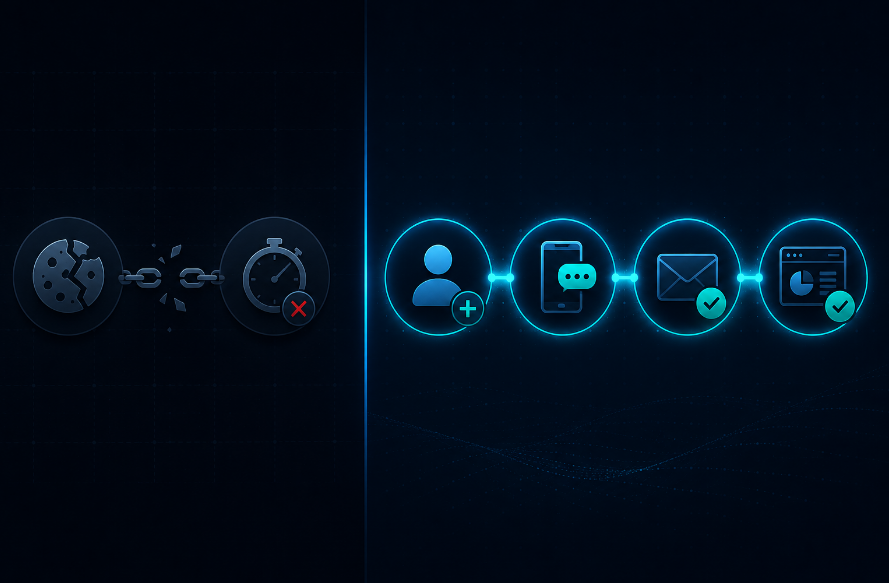
Both approaches degrade in the same way over time. Recorded sessions expire. Tokens rotate. Multi-factor authentication prompts break session replay. When the frontend changes a new field on a signup form, a redesigned checkout flow the recorded flow breaks. The scan continues to run and continues to return clean results, but the application it is testing is no longer the one currently in production.
Why Record-and-Replay Does Not Solve the Problem
Recording a login flow and replaying the resulting session captures a single snapshot of a static state. It does not capture the process a real user goes through, and it cannot adapt when that process changes.
A typical user registration flow on a modern SaaS application includes:
- Completing a registration form
- Receiving and submitting a one-time password (OTP), often within a limited time window
- Completing email verification
- Landing on a dashboard that renders differently based on role, plan, or onboarding state
- Triggering dozens of API calls that are never visible in the UI, each governed by its own authorization logic
A replayed session skips this entire sequence. As a result, it cannot surface the vulnerabilities that exist specifically within that sequence: weak OTP rate limiting, predictable password reset tokens, email verification bypasses, or IDOR conditions between two newly created accounts. These issues are identified by executing the flow, not by replaying a saved credential.
This is consistent with findings across security assessments more broadly: authentication-related flaws account for a disproportionate share of critical vulnerabilities, yet remain among the least consistently tested areas, precisely because testing them requires active interaction rather than passive crawling.
What Authenticated Testing Requires
A skilled human penetration tester does not request a session cookie before beginning an assessment. They register an account, complete OTP and email verification, and proceed through onboarding as a genuine user would because this is often where the most significant logic flaws exist. Relevant questions at this stage typically include whether a verification step can be skipped, whether an OTP request can be intercepted or replayed, and whether a second account can be used to access data belonging to the first.
This type of testing business logic testing requires an actor capable of the following:
- Independent registration - creating accounts, verifying emails, and receiving and submitting OTPs without manual intervention
- Contextual understanding - recognizing that a password reset flow and an email change flow may share an underlying token-generation weakness, despite appearing unrelated
- Adaptation to change - continuing to function correctly when a form field moves, a new verification step is introduced, or an API response structure changes
- Cross-step reasoning - connecting an action taken several requests earlier to a vulnerability that only becomes exploitable later in the flow
Traditional scanners are not designed to perform this type of testing. They are effective at matching request/response pairs against known signatures a strength when identifying SQL injection, XSS, outdated dependencies, or missing security headers. They are not designed for contextual reasoning across a multi-step process, because that requires judgment rather than pattern matching.
This is the specific gap AI agents are designed to close. Where a traditional scanner requires a session to be provided to it, an AI agent can register independently, receive an OTP on its own number, complete email verification, and proceed through the application as a new user would. Axeploit is built around this capability directly: it signs up, verifies, and logs into a target application independently before beginning vulnerability testing.
The Ongoing Cost of Manual Scanner Integration
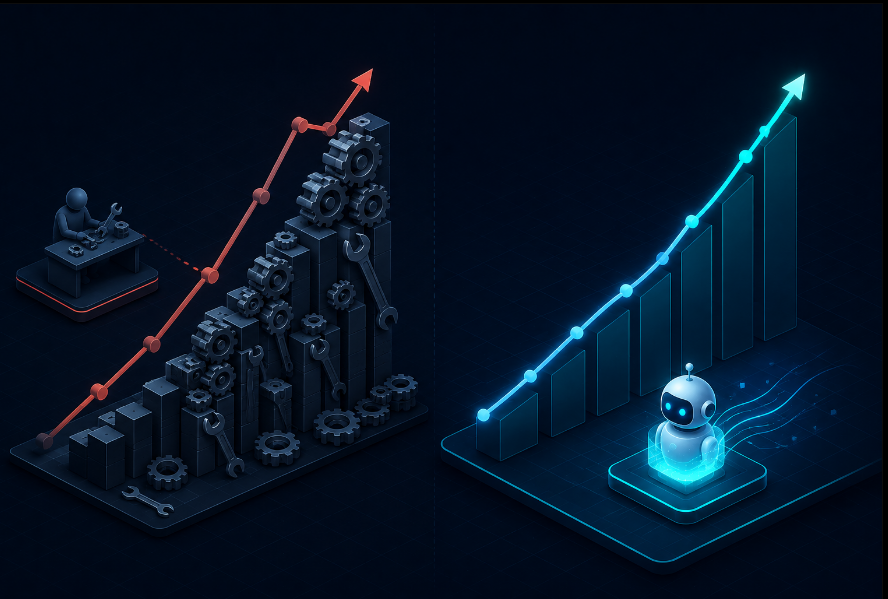
A related limitation of traditional scanners is that they require continuous manual configuration to remain accurate. Every new endpoint, every change to an API contract, and every adjustment to permission levels requires someone to update the scanner's configuration accordingly.
For an organization managing dozens of APIs, this is not a one-time setup cost. It is a recurring maintenance obligation, repeated with every release cycle, and typically absorbed by engineering or security staff without being explicitly budgeted as ongoing work.
An agent capable of authenticating, exploring, and reasoning about what it discovers does not require this maintenance cycle in the same way. It identifies the current structure of the application through direct observation rather than manual configuration, in the same way a new engineer would explore an unfamiliar codebase.
Coverage at Scale
A reasonable concern with autonomous testing agents is whether increased coverage comes at the cost of precision whether an agent operating independently against a production application introduces unnecessary noise, misinterprets business logic, or generates a volume of false positives comparable to the output it was meant to replace.
This concern is valid for a general-purpose agent an LLM operating a headless browser with loosely defined instructions will typically produce inconsistent results. A security-specific agent, built with a continuously updated CVE and zero-day intelligence feed, a structured library of authentication and fuzzing patterns, and systematic coverage of a defined set of vulnerability classes, operates differently. It functions less like an unsupervised process and more like a methodical tester working through a defined scope at machine speed.
The distinction is important: the objective is not to trade precision for coverage, but to achieve both an actor capable of authenticating, exploring, and reasoning through business logic in the way a human tester would, applied consistently across every API a modern application exposes.
Coverage Decay Is a Silent Failure
A further limitation of static scanning approaches is that they do not indicate when they have stopped being effective. A scanner that functioned correctly against a login page several months ago does not report that it has stopped functioning correctly. It continues to return clean results, and clean results are generally interpreted as an indication of good security posture rather than a signal to investigate further. Meanwhile, the application's frontend may have been redesigned multiple times, new API versions may have shipped, and the scanner may be reporting on a version of the application that no longer exists in production.
An agent capable of adapting to layout and flow changes in real time rather than depending on a script recorded against a specific UI state does not exhibit this failure mode in the same way. It re-establishes an understanding of the application on each run, rather than relying on a fixed prior configuration.
Implications for Security Teams
This is not an argument that traditional scanners have no role. They remain effective for fast, low-cost detection of known technical vulnerabilities across the unauthenticated surface of an application, and should continue to be used for that purpose. The more specific point is that a scanning strategy limited to the unauthenticated surface addresses only a fraction of the application and should not be treated as comprehensive coverage.
The vulnerabilities most commonly associated with significant breaches are rarely missing security headers. They are more often guessable password reset tokens, unrated OTP endpoints, or IDOR conditions between accounts that were never intended to interact. These issues exist specifically in the areas traditional scanners cannot reach, and specifically in the areas AI agents capable of authentication and business-logic reasoning are designed to operate.
When evaluating a scanning tool, the more relevant question is not how many CVEs it checks for, but whether it can authenticate into the application at all.

This is the gap Axeploit is designed to address. Rather than requiring teams to provide credentials, maintain recorded login sessions, or manually integrate a growing list of API endpoints, Axeploit registers with a target application using its own email address and phone number, completes OTP and email verification, and reaches the authenticated dashboard independently. From there, it tests for over 7,500 known vulnerability patterns, supported by continuously updated CVE intelligence and one of the industry's largest password and fuzzing databases. It adapts to frontend changes, supports scoped scans of specific flows without a full re-record, and reports findings in a format security teams can act on directly without the extended gaps during which a scanner has silently stopped assessing the current version of the application.
Traditional scanners were designed for applications that exposed most of their functionality publicly. Modern applications do not. A testing strategy that stops at the login page is, by definition, incomplete.